Saturday, July 30, 2011

Towada Kokeshi 十和田こけし

In the heart of Aomori Prefecture is a magnificent crater lake called Lake Towada (十和田湖). Before our big Tohoku trip began we had read on a Japanese kokeshi blog that there was a traditional kokeshi shop near the lake, so our visit to Towada also became a kokeshi adventure.
Towada Kokeshi exterior view.
The directions we created using Google Maps were vague for some reason, possibly because of a new road and tunnel that leads to the tourist area where numerous souvenir shops, restaurants, and inns are located. While we had a wonderful drive up through Oirase Gorge and along the lakeshore, it did get confusing. Fortunately an old lady on the side of the road pointed us in the right direction, and soon we had arrived at Towada Kokeshi, a large sovenier shop that also sells kokeshis made by Mr. Takase Tokio (高瀬時男). Interestingly, although the shop is in the heart of Aomori Prefecture Mr. Takase's kokeshis are not of the Tsugaru Type (津軽系). Instead they are a unique version of a Naruko Style (鳴子系), according to some on-line Japanese sources. What undoubtedly makes some of them unique is the Daruma faces painted on them, one of the design features of Tsugaru kokeshis. Are Takase kokeshis hybrids?
Anyway, we were happy to find the place, examine and photograph the kokeshis, and talk with Mr. Takase's son who told us that things have gotten really bad for all of the local businesses at Towada since the nuclear disaster. Tourism has almost completely dried up, and not only are people not visiting from the Tokyo area, but they're also not coming down from Hokkaido, apparently out of fear of radiation in the Tohoku. This is misplaced fear by the way -- I recently checked radiation levels for Japan's prefectures and Aomori (as well as Akita, Yamagata, and Iwate) are much lower than the Kanto Plain. If the tourists do not return to Aomori it's pretty clear what will happen to Towada Kokeshi and the other shops, restaurants and inns along the lake. When we were there on a perfect late June day you could have counted the number of visitors on two hands.
Medium-sized Takase kokeshis.
Meanwhile, the Towada Kokeshi shop was festooned with a number of kokeshi-themed noren (暖簾), those split doorway curtains that one sees hanging in front of traditional restaurants in Japan. Of course we had to get one, but when we tried to make the purchase we were told that the people who make the norens have been displaced because of the earthquake disaster and it's unclear when they'll be available again. The  ones on display were not for sale. Too bad -- kokeshi norens are pretty cool!
Although this was a genuine kokeshi adventure, and we bought three Takase kokeshis of various sizes, the visit was certainly tinged with some melancholy. American and foreign readers: The impact of the 3-11 disaster is real, is far-reaching, and there's still no end in sight for many because of the Fukushima disaster. If you can support the kokeshi makers and other traditional craftsmen please do. The best way would be to visit northeastern Japan as a tourist, but if that's not possible at the very least please keep these folks in your thoughts and prayers.

Ejiko (えじこ) kokeshis and a Daruma.
Large and giant Takase kokeshis.
Kokeshi-design noren.
In the shop.
The sign says: "Welcome. Takase. Kokeshis of Lake Towada."


Sunday, July 17, 2011

Honma Kokeshi Workshop 本間こけし工房

Aomori's stunning Oirase Gorge.
To me northeastern Japan -- Tohoku -- is a very different Japan than the Tokyo area. Tsunamis and massive earthquakes notwithstanding, the air and rivers there are cleaner, the population is much thinner, and the countryside is distinctly prettier. To my pleasant surprise the region also seems more prosperous than when we lived there sixteen years prior -- the roads are markedly better, the houses appear bigger and newer, and the people's spirits seem more radiant. Maybe it was the new bullet train line that the East Japan Railway Company just extended to Aomori City, finally connecting northernmost Honshu into the nation's high-speed rail network. If it wasn't for the Fukushima power plant disaster I am certain that Tohoku would be facing a bright future, despite the March 11th tsunami. The Fukushima disaster has changed everything, and has added a large degree of uncertainty that everyone in Japan feels. At the same time, though, everywhere we went up north were signs saying Gambaro Tohoku! ("You can do it Tohoku!"), so they're perservering as best they can.
Gambaro Tohoku!
Generally speaking northeastern Japan remains largely agricultural and traditional. This, in my opinion, is a good thing. Among those traditions, of course, is kokeshi making, and it was to visit some craftsmen that Naoko, the girls and I headed up north. While our side trip to Tsuchiyu Onsen (see previous blogs) was certainly a serendipitous adventure, our drive to meet kokeshi maker Naoko Honma was not. We called her before our trip even started and made an appointment to ensure that she would be available. On 20 June we headed through the rolling hills of western Aormori prefecture, soon arriving at the small town of Kamikita (上北町). Despite Kamikita's small size we still managed to get lost and were already driving out of town when we realized that we had better call Mrs. Honma and get new directions. As I've mentioned in other blog posts, going to some kokeshi makers' workshops is not always easy and often requires native or high-level Japanese language skills. That was the case in this instance. Oh, and did I say "craftsmen" earlier? Yes, some kokeshi makers, like Naoko Honma, are indeed women.

Mrs. Honma's workshop.
Baby Honma kokeshis. Cute.
We finally arrived at the workshop which, like many we've been to, was simply a shed connected to the house. Mrs. Honma welcomed us in like old friends and served Aomori apple juice, local coffee, and local nagaimo (literally "long-potato", or Chinese yam) donuts which were just outstanding. She showed us her lathe and some recent projects, which were all terrific, and then she and Naoko proceeded to talk about all sorts of things, including the art of the Tsugaru kokeshi. Mrs. Honma works in the Tsugaru style (津軽系) like most kokeshi makers in Aomori Prefecture. As such, her kokeshis tend to follow the typical strictures of that school -- defined chest and waist, Ainu pattern around the neck, often a painting of Daruma's face, etc -- and are beautiful. She first started making kokeshis 30 years ago, and during that time has been able to develop a few additions of her own. On the day we visited she had created a small, demure young girl that is definitely a "Honma" design, as well as some medium and small ones painted with her own design which is a verdant maple leaf on a dark green background. Are were delightful, and of course we walked away with some wonderful pieces. Interestingly, the larger one we purchased was wrapped in plastic, which is something one sees with Tsugaru kokeshis.
Apple juice, donuts, and kokeshis.
According to Mrs. Honma, one doesn't take the plastic off. Rather, you simply wait until it falls away while the paint cures (this can take a while). Unlike most other kokeshi types, Tsugaru kokeshis are not waxed and thus when freshly made the paint will rub off on one's hands quite easily. Therefore, our larger Honma kokeshi will be in its plastic cover for the foreseeable future.
Overall, it was a pleasure to meet such a master craftsman as Mrs. Honma, and was a great way to start our big Tohoku kokeshi adventure!


The two Naokos discussing the finer points of the Tsugaru kokeshi tradition.
Mrs. Honma's workshop and some recently completed kokeshis. Note the plastic covers: Do not remove!
Mrs. Honma's kokeshis. The one on the left is a standard Tsugaru. The rest are unique designs. 


Monday, July 4, 2011

Tsuchiyu Kokeshis 土湯のこけし, Part II

Tsuchiyu's giant welcoming kokeshi.
(Continued from the previous blog entry) After leaving the Watanabe's kokeshi shop we followed the signs to the main part of Tsuchiyu, which was really just a series of buildings along the side of the beautiful Ara River (荒川) flowing from the mountains above. As noted in the previous blog, kokeshis and kokeshi images were everywhere in Tsuchiyu, including an enormous one made by Mr. Watanabe housed in a protective shed. After Naoko stopped by the visitor center for information we walked through the rain and immediately found a kokeshi shop and cafe that apparently catered to serious collectors. I say this because it had beautiful examples of traditional kokeshis from throughout Tohoku for sale. The owner said that the March 11th earthquake and major aftershocks knocked over everything three times, and that in total he lost about 100 pieces. We continued walking and a couple of shops down the street was a store selling traditional wooden Japanese toys, which also housed hundreds of old kokeshis housed in glass cases. As we strolled along further we saw a kokeshi-maker's shop that was closed and had to keep going. We stopped for a while at a free foot hot bath (足湯) decorated with kokeshi-head lanterns, and then found a bridge guarded by enormous kokeshis. Was this kokeshi heaven? All I know is that if you throw a stone in any direction in Tsuchiyu you will hit something related to kokeshis.
At this point it was lunchtime and Naoko knew of a soba (Japanese buckwheat noodles) restaurant with
Giant bridge kokeshis. There are two more on the other side.
some sort of kokeshi connection further up the street, which we soon found. The "kokeshi connection" was actually quite deep, and everything in the restaurant was kokeshi themed. Even the chef wore a hapi coat with a kokeshi face on the back. After a delicious lunch we found out why -- the man who made our soba was Mr. Yukinori Jinnohara (陣野原幸紀), a famous kokeshi maker! I suppose we shouldn't have been surprised. Naoko couldn't resist buying a couple of his large-scale kokeshis. Our last stop in town was what appeared to be a regular souvenier shop that sold kokeshis, but was also a kokeshi maker's workshop -- Mr. Kunitoshi Abe (阿部国敏). Unfortunately for us Mr. Abe was in Tokyo selling his complete supply of kokeshis, so we didn't get any of his pieces. However, we did find a couple of nice Tsuchiyu kokeshis made by some other craftsmen. The lady who owned the shop, Mrs. Abe, told us how difficult things had become since the earthquake, and that she wasn't sure how much longer she'd be able to keep her shop open. Fortunately one of her son's kokeshi designs has recently become a hit, but clearly times are tough in this place. Despite economic difficulties she gave our girls a couple of wooden tops as gifts. In fact every shop we went into gave our daughters presents -- absolutely unbelievable.
Mr. Jinnohara makes soba and kokeshis.
Overall our unplanned visit to Tsuchiyu was a really great start to our big kokeshi adventure. However, although everyone was welcoming and kind we left with mixed emotions. First of all, there was the nuclear issue. I suppose we might have been exposed to some radiation while in Tsuchiyu, but I believe the real concern is long-term exposure so three hours there for us was a calculated risk. Nevertheless, how will the radiation effect the people who live there? Also, from what we could tell the town of Tsuchiyu is in serious trouble. We only saw one building seriously damaged by the earthquake, and currently the hotels and inns are filled with refugees from the disaster area at the Japanese government's expense. While that is undoubtedly good for the hotel owners, it is not good for shopkeepers, restaurant owners, and kokeshi makers since the refugees are not buying kokeshis or eating out. Among the people we talked to there is serious concern for the town's future. The refugees will be leaving soon which will free up hotel rooms, but will tourists want to come to a place that is so close to the Fukushima power plant disaster area? What will happen to the kokeshi makers and the Tsuchiyu tradition, and will Mr. Watanabe find a new source for the pear wood that he prefers to use? These are questions beyond the ken of a humble blog, but they're worth pondering nonetheless. 
Next blog: Kokeshis of Aomori Prefecture.
This kokeshi shop was closed when we were in Tsuchiyu.
Mr. Jinnohara's soba shop.
A kokeshi shop and cafe in Tsuchiyu. All the kokeshis here fell over three times during the earthquake and aftershocks.
A Japanese wooden toy shop and small kokeshi museum. 
Matsuya Souveniers. It is also Mr. Abe's kokeshi workshop.
Inside Matsuya Souveniers.


Sunday, July 3, 2011

Tsuchiyu Kokeshis 土湯のこけし

Tsuchiyu Onsen manhole cover.
On the morning of June 18th we began our 10-day Tohoku kokeshi adventure. Our plan was to stay in eastern Aomori prefecture, and from there we would array out and visit the sites and kokeshi makers throughout the prefecture. We also needed to get through, as quickly as possible, the US government's 50-mile (80km) radioactivity danger-zone around the Fukushima Number 1 power plant disaster area. As everyone in Japan knows, both the bullet train and highway go fairly close to the power plant. By about 6:30 am we were on the Tohoku highway traveling north with a surprisingly large number of vehicles, including government disaster-relief trucks. It was smooth sailing until we had entered the exclusion zone due west of the power plant. At that point the traffic thickened, and then we stopped moving entirely -- there had been a serious accident on the highway and everyone going north was being forced to exit the highway and use the local road -- Route 4 -- that paralleled it. Perhaps it was fate, but at that point Naoko noticed that the exit we were sitting at happened to be the exit for Tsuchiyu Onsen (土湯温泉), a famous hot bath and kokeshi town in Fukushima Prefecture! Weighing the option of not moving on the highway or driving into the nearby mountains to visit a kokeshi-making area was not a difficult decision, and soon we were speeding through the beautiful countryside on a perfect early summer day. Although the area was definitely contaminated with some radiation (we saw a school playing field whose soil was being scraped and dumped into a pit), the situation generally seemed normal. After winding up the mountain we entered a tunnel, and the moment we came out of the tunnel we saw a small shop with a sign that said "kokeshi." We weren't even in the main part of town yet and our kokeshi adventure had officially begun.
Watanabe's kokeshi shop.
The identity of Tsuchiyu is wrapped up with kokeshis as much as it is with onsens. It really is a true onsen-kokeshi town which even has its own Tsuchiyu style (土湯系), easily recognizable by the "snake eye" pattern (蛇の目) on the top of the head along with the liberal use of green and red squiggly lines along with horizontal stripes. The noses also tend to be drawn in a U-shape, which is called maruhana (丸鼻 = "round nose") in Japanese. There are kokeshi-related signs everywhere in Tsuchiyu, the lanterns are kokeshi heads, and even the manhole covers have kokeshis on them -- really cool. The shop we first stopped at after exiting the tunnel was that of Mr. Tetsuo Watanabe, who of course creates kokeshis in the Tsuchiyu style using, uniquely, pear-tree wood. Because of the disaster he is no longer able to get the wood he likes, so it's not clear what will happen once his wood supply runs out. Anyway, his kokeshis were beautiful, and the pear wood he uses has a pleasing dark brown color. Naoko and Mr. Watanabe chatted about kokeshis for a bit while his wife fed us some snacks. Besides his regular kokeshis he showed us an exquisite traditional shichifukujin ireko (七福神入れ子 = Seven Gods of Happiness nesting doll) kokeshi that he created, and though tempting at 35,000 yen we had to pass. Their small shop was hit really hard by the March 11th earthquake which knocked almost everything over, including a giant kokeshi that was on display. We bought a couple of beautiful Watanabe kokeshis, and after about an hour we bid these delightful people a fond farewell and headed into Tsuchiyu town. What would we find there? (continued in next blog entry)
Tsuchiyu kokeshis. Note the "snake's eye" on the head, and round U-shaped noses.
Naoko discussing Mr. Watanabe's ireko kokeshi. The giant kokeshi in the middle toppled during the 11 March earthquake.
Kokeshi art like this is all over the town of Tsuchiyu.
Kokeshi-head lanterns.

Thursday, June 30, 2011

A Major Kokeshi Adventure

Along the highway.
I have documented various kokeshi adventures in this blog over the last few months. These trips have chiefly occurred in Tokyo or Gunma, with one to southern Fukushima Prefecture. However, from 18-27 June Naoko, the girls, and I upped the level of adventure dramatically by braving radioactivity and earthquake damage -- signs of which were everywhere -- and headed north into Tohoku (東北), the heartland of the traditional kokeshi world. Over the next few blog entries I'll recount the adventure's highlights, however here is an overview of our trip: On 18 June we visited Tsuchiyu Onsen (土湯温泉), a famous hot bath and kokeshi town in Fukushima (about 43 miles west-northwest of the nuclear power plant disaster area), for a couple of hours on our way to Misawa City (三沢市) in Aomori Prefecture (青森県). On 20 June we went to see a lone Tsugaru-style (津軽系) kokeshi maker in Kamikita Village (上北村), followed by a visit to an old kokeshi shop on the shore of Lake Towada (十和田湖). On 23 June,
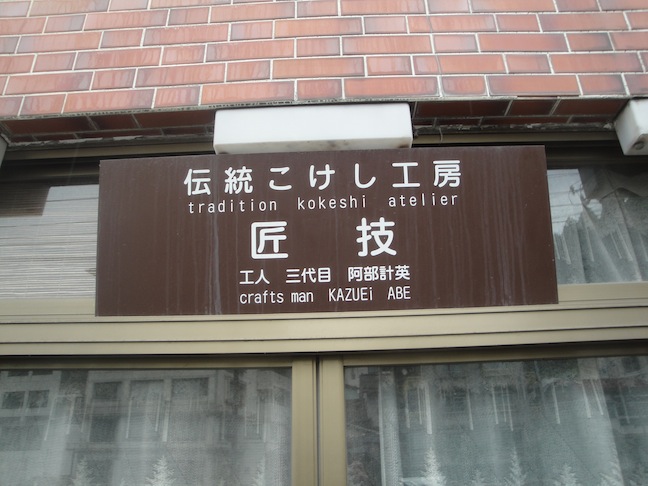
Shop sign.
after a two-day break from kokeshis, we crossed Mt. Hakkoda and passed through the onsen town of Kuroishi (黒石市) and headed to Hirosaki City (弘前市) where we met a couple of kokeshi makers at that city's "Neputa Mura" (ねぷた村) traditional crafts center. On 25 June we left Misawa for Kuroishi where we stayed in the onsen village of Nuruyu (温湯温泉), which is also a kokeshi-making area. On that day we visited a kokeshi maker's workshop, and then headed to the spectacular Kokeshi Museum (こけし館) in the hills outside Kuroishi. On 26 June we returned to the Kokeshi Museum for a couple of hours, and then headed south to Yuzawa Onsen (湯沢温泉) in Akita Prefecture (秋田県) where we spent the night and met a kokeshi maker of the Kijiyama Style (木地山系). On 27 June we headed through the heart of Yamagata Prefecture (山形県) to Tendo Onsen (天童温泉) where we visited two Yamagata Style (山形系) kokeshi makers' shops.


Kokeshi lantern.
While this wasn't exactly the "kokeshi adventure to end all kokeshi adventures," it was pretty spectacular. We made lots of news friends, sampled delicious local foods, relaxed in many hot baths, immersed ourselves in the beautiful Tohoku countryside, and of course added plenty of new kokeshis to our collection. It was also, in a small way, our way of letting the people of northeastern Japan know that they haven't been forgotten in the post-disaster period. Over the next few days I look forward to providing detailed blog accounts of this significant kokeshi adventure.

Sunday, June 12, 2011

Mini Kokeshis

We saw these in the Usaburo factory museum.
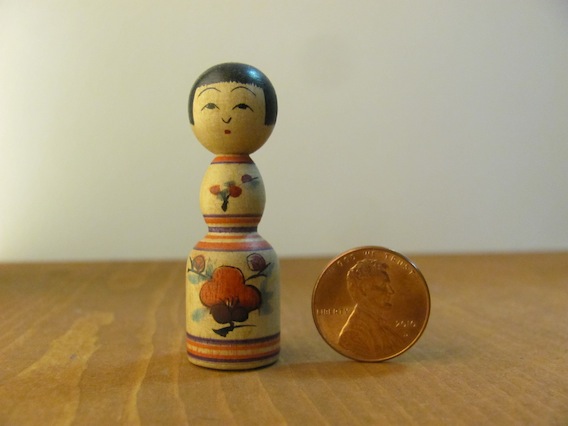
There's a branch of the kokeshi world that goes beyond small into the realm of tiny. I'll call them mini-kokeshis for lack of a better term. These little guys are amazing, and among traditional kokeshis they are often exact duplicates of their larger sisters. Believe it or not these aren't the smallest ones out there, but I'll save those for another blog. If one were to specialize in mini-kokeshis he could have hundreds in the same space as dozens of regular-sized kokeshis. Naoko seems to prefer them, and we've heard that young Japanese females really like them for their cuteness. Therefore, we'll probably see more of these in the future.
Our first mini-kokeshis were two modern ones received from Naoko's dear old aunt. She had purchased them as souveniers decades ago, and when she found out that we liked kokeshis she gave them to us. One can see their diminutive size by comparing them to an American penny. By the way, we know that these are Usaburo kokeshis from Gunma Prefecture since we saw them displayed in the museum at the Usaburo factory (see blog post). Therefore, we have a couple of museum pieces in our collection!
We found another mini-kokeshi recently at a local bazaar, which is possibly a Yajiro (弥治郎系). It was about 150 yen, a more-than-reasonable price, especially considering its condition. It's about 2.5 times the size of a penny.
The Sato (佐藤) family makes mini Yajiro kokeshis. We visited their workshop in Iwaki City, Fukushima on March 6th (see blog post), and less than a week later they were forced to move to Gunma Prefecture as a result of the March 11th earthquake and tsunami disaster. I'll discuss that in a future blog. Important here is that the Satos also make mini-kokeshis. In fact Mr. Sato told Naoko that his tiny ones (he makes at least ten different ones) are really the peak of his craft because they require such fine detail. See what you think.

A tiny Sato kokeshi. The hand-painted detail is stunning.
Another tiny Sato kokeshi next to a regular-sized Sato piece.
The same tiny kokeshi. For perspective, here's a Princess Leia action figure dwarfing the mini-kokeshi.


Kijiyama Kokeshis in Hachioji 八王子の木地山系こけし

Okuragumi Demolition Company.
Back in February Naoko, Emily and I had a fantastic Kokeshi Adventure in Hachioji, a large city within the greater Tokyo metro area near the mountains in the western part of the Kanto Plain. As reported in a blog back at that time, we visited the workshop and studio of Tokyo Kokeshi in the heart of Hachioji. On that same day we also visited Mr. Ogura Eiji (小椋英二さん) at his workplace in the suburbs of Hachioji, guided by information found in the Kokeshi Book. Unlike other kokeshi makers we've met, Mr. Ogura seems to do his art as a hobby. He does not have a workshop -- at least not one open to the public -- and in fact probably does not lathe the kokeshi bodies himself. We called him before showing up, and the person who answered was confused. "Kokeshis? What?" But Naoko explained about seeing his name in the Kokeshi Book, and we then received directions to what we thought was his "studio." After arriving it became clear why the person on the phone had no idea what we were talking about. Mr. Ogura, you see, is the owner of a demolition company called Oguragumi, and merely keeps some of his dolls in his office at the company for when visitors stop by. In my opinion the contrast between someone who demolishes buildings for a living, and one who makes kokeshi dolls couldn't be greater. Yet that's the way things are, and the Okuragumi building's giant rolling door depicts a mural of three kokeshis and a craftsman in honor of the tradition.
Okuragumi's giant kokeshi mural.
Anyway, Mr. Ogura's kokeshis are splendid -- earthy, understated, and folksy, with delightfully expressive faces. They are of the Kijiyama family (木地山系) of kokeshis that originated in Akita Prefecture (秋田県), and in fact his uncle was the famous kokeshi craftsman Ogura Kyutaro (小椋久太郎) from Akita. We were welcomed into the main office where a number of Mr. Ogura's kokeshis were on display, offered tea and juice, and simply enjoyed being around these beautifully crafted objects for about 20 minutes. Because this was an early kokeshi adventure we didn't really quite know what we were seeing, but it was definitely well worth the effort!


A selection of Mr. Ogura's kokeshis.
I really liked these. They have an unusual vase-shaped body.
A group of Ogura kokeshis.
Two giant kokeshis by Mr. Ogura's uncle Ogura Kyutaro.
Naoko was captivated by this one's charming face -- a true work of kokeshi art.