Tuesday, December 13, 2011

Tsugaru Kokeshi Kan 1 津軽こけし館1

There are a few kokeshi Meccas out there, and one of them has to be the Tsugaru Kokeshi Kan in the hills outside of Kuroishi City in western Aomori Prefecture. First and foremost it's a museum with a fantastic collection 5,000 kokeshis, which I'll cover in the next blog. More importantly is that the Kokeshi Kan is a venue for Aomori-based artisans to sit at the lathe, demonstrate their craft, and talk to guests. In that sense Kokeshi Kan is also a cultural center. Finally, it has a fantastic gift shop that is in honor of Tsugaru and other traditional kokeshis. Naoko and I visited this place back in 1994 or so, and all I remember is a dark, stodgy, government-owned facility that merely housed the kokeshi collection. I do not recall a gift shop, nor do I remember such the bright, vibrant atmosphere that one finds at the Kokeshi Kan today. The current management has to be behind this change: They are young and innovative, and really understand what is appealing about kokeshis. This comes out in the tasteful design of the shop, and what is for sale. For more info (in Japanese of course) see the official web site: http://tsugarukokeshi.com/index.html. Next installment: A visit to the museum floor!

Exterior shot of the Kokeshi Kan, one of the Meccas for the kokeshi world. As far as I'm concerned all kokeshi enthusiasts must make the trip here at some point.
Tsugaru Kokeshi Kan memorial plaque. The building was constructed by the old National Land Agency as a local project from 1985 to 1987.
There were a number of these Tsugaru kokeshi lanterns around the Kokeshi Kan.
Naoko talking with the Kokeshi Kan's manager Mr. Yamada.
Some beautiful Tsugaru kokeshis from various makers for sale in the gift shop.
More Tsugaru kokeshis in the gift shop.
Abo family Darumas in the gift shop. What a really great design, and the primary colors make them stick out. Too bad I didn't get one, but then I could say that about a lot of kokeshis during this trip.
An explanatory display about Tsugaru kokeshis. Naoko provided the English translation a few weeks before we arrived.
Ah, the kids section. Many of these items are Tsugaru-related key chains and knicknacks. Some are kokeshi related too.
These little guys are attached to an address card and are for mailing through the Japanese postal service. I don't know if it's an old tradition, but it's a fun one.
Local Tsugaru foods -- look closely and see if there's a kokeshi on the label.
Kokeshis for sale. We managed to hold off on purchases (for the most part), instead waiting until we met the makers in their workshops.
Giant kokeshi-art mural in the Kokeshi Kan work room.
The biggest wooden kokeshi in the world standing with a giant wooden Daruma and Tsugaru kokeshi lantern. I didn't ask, but I wonder if this stayed standing after the 3-11 earthquake...
I loved this one. I don't know if this kokeshi was purposely stained orange, or it became orangish over time, but its coloring is unusual and striking.
Yep, there's one of these cut-outs for photos, and luckily the girls are always willing to become kokeshis.
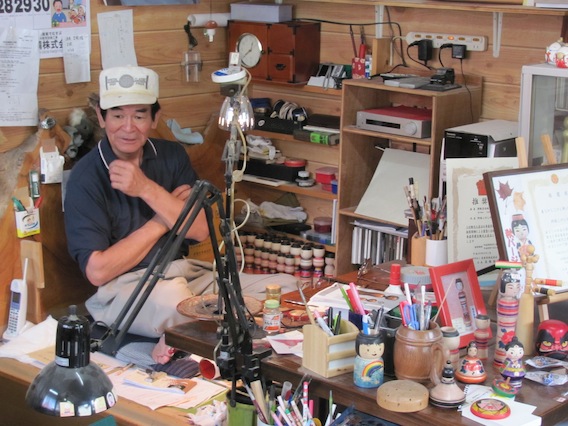
I think the Kokeshi Kan exists as much to promote local kokeshi makers and the kokeshi tradition as it is a museum.  On this day master craftsman Mr. Mori Mitsuo 盛美津雄さん, a direct decendent of the originator of the Tsugaru kokeshi, was giving a demonstration. 
On the way up to the second floor and the museum is this cool kokeshi kite. Kites are a Tsugaru tradition, so it's doubly cool.

Friday, December 2, 2011

Abo Kokeshi in Nuruyu Onsen 温湯温泉の阿保こけし

The Abo's house and workshop. The top of the sign says "Welcome to Kuroishi."
On June 25th we left western Aomori and headed due east toward Nuruyu Onsen 温湯温泉 in the hills outside of Kuroishi, our next overnight destination. For most of our trip we had spectacular weather, and this day was no different -- a cool breeze was blowing under a slightly hazy but bright blue sky without a hint of the brown that normally mars Tokyo's skies. That's Tohoku in the summer.
We made good time on the Tohoku expressway and found that we were too early to check into our room at the onsen, so  what does one do on a kokeshi adventure? Why, hunt for kokeshis of course, and luckily we no trouble finding the Abo kokeshi workshop 阿保こけしや.

At the Abo's you slide open the door, put on some slippers, and observe kokeshis as Naoko is demonstrating above.

The Abo's are a father (Muchihide 六知秀) and son (Masafumi 正文) kokeshi team of the Tsugaru tradition, making both the classical narrow waist type, and another, more primitive-looking branch of the Tsugaru style that's mostly bare wood, a realistic face, thin neck, and limited striping. I'm a big fan of the primitive style, and although I'm hardly an expert I would argue that they are almost a kokeshi type unto themselves. I wonder why the disctinction doesn't exist? Or maybe it does. Anyway, the elder Abo started making kokeshis in 1969 so he's been doing this for a long time, while the younger has only been doing it for a couple of years. Based on what I've seen I'd say he's already a master. The photos below should speak for themselves.

Abo kokeshis for sale. Absolutely stunning work.

Our visit with the Abo family was delightful. As we find with so many of kokeshi makers, they welcomed us right in and seemed delighted that we had taken an interest in their craft. Naoko spent a good deal of time talking with Mr. Abo, while Mrs. Abo knew just what to do with our two energetic girls -- put them to work making their own kokeshis. Unlike most do-it-yourself kokeshis where you replicate a "real" kokeshi, Mrs. Abo had metallic colored pens and stickers, just the kinds of things to keep the attention of young girls. They did a good job too! After they were done with the kokeshis we strolled leisurely through a neighboring apple orchard. Ah, Tsugaru! I truly love this part of Japan. I think we must have been with the Abos for a couple of hours, and we had a wonderful time. Naturally we purchased a selection of their beautiful works, and left with fond memories of this warm-hearted kokeshi-making family.

I've always wondered if kokeshis could successfully be done in modern garb. As a matter of fact, yes they can. 
We bought these two Abo "primitives" as I'll call them, especially in contrast to the large, refined one in the background. The one on the left is by Muchihide-san, while the one on the right is by Masafumi-san. This branch of the Tsugaru kokeshis really has the feel of folk art, which I like.
A closer view of some classical Tsugarus. Note that the smaller ones are 3,000 yen, or about $36 US. That may or may not seem expensive, but that price buys you a piece of perfectly hand crafted, hand-painted art. We bought the big one. The plastic wrapper is to protect from smudging the paint, and it has been recommend to us to keep the wrapper on the kokeshi until it deteriorates away.
Mr. Abo's kokeshi painting area. 
The same spot as above. Note the semi-completed kokeshis awaiting their faces. They really are all hand painted.
Mrs. Abo knew just how to handle the girls, keeping them busy for a while creating their own kokeshis.
The apple orchard right next to the Abo's workshop. This part of Japan is idyllic to me.
Some whimsical hula kokeshis. Mr. Abo occasionally takes orders for painting real faces on kokeshis, and he showed us one he had made for an American. By God, it looked just like the guy!
A masterful male Hina kokeshi 雛こけし, with a female in the background. These are a separate branch of the kokeshi world (Naoko's a fan) that could easily replace the traditional dolls one sees during the Hinamatsuri 雛祭り. Hina dolls are normally not made out of wood, so these are very unique.
Kokeshi-making tools. 
One of the Abo family's lathes.

Tuesday, November 29, 2011

Hirosaki Kokeshi 弘前のこけし

After leaving Okuse's kokeshi workshop in Kuroishi City (see previous blog) we headed east out of the hills toward downtown Hirosaki City 弘前市, a beautiful old castle town. Right next to the castle ruins is the Hirosaki Neputa Kan 弘前ねぷた館, a centralized cultural heritage center for the arts of Tsugaru, from kite makers, weavers, and musicians, to a couple of kokeshi makers. Of course we went there to meet the kokeshi makers, but I must say that the Hirosaki Nebuta Kan is a first-rate destination for all sorts of traditional arts from this part of Japan.    

External view of the Hirosaki Neputa Kan.

I'll let the photos below tell the story, but we did meet two kokeshi makers of the Tsugaru tradition from the Owani Onsen 大鰐温泉 branch: Mr. Hasegawa Kenzo 長谷川健三さん and son Mr. Hasegawa Masashi 長谷川優志さん both of whom live in Hirosaki and do their work in the Neputa Kan. A number of traditional handicrafts are alive in the Tsugaru region, and the Neputa Kan showcases and supports them. Really a great idea, and the fact that a section is devoted to kokeshis shows the importance of that craft. Of course we bought a couple of Hasegawa kokeshis that grace our collection, and as always it was fun to talk with the makers.
Our summer kokeshi adventure was continuing splendidly! 
Interior view where many of the artisans are located. Really a great idea.
Lena and Emily chatting with a kite maker. Kites and kite art are a Hirosaki tradition.
Hasegawa Kenzo at his workshop right in the heart of the Hirosaki Neputa Kan facility.
Observing the younger Hasegawa at his lathe. You have to love that noren 暖簾 hanging in the doorway.
Hasegawa Masashi turning out a kokeshi on his lathe.
A shelf of Hasegawa kokeshis.
A small army of Hasegawa kokeshis. I bought one of the tall ones in the back, which the elder Hasegawa considers his masterpiece.
Darumas are part of the kokeshi tradition and they always make me laugh. These are unique and fantastic.
Mr. Hasegawa shows off some of his tops to Lena. He has invented a 3-piece top that works great.
Kokeshis on display, as well as cords of wood that will someday become kokeshis. The dolls on the top were not for sale  by the way.
All hand painted -- simply amazing craftsmanship.


Friday, November 25, 2011

Kuroishi Kokeshi 黒石のこけし

The heartland of Aomori Prefecture's kokeshi tradition is the northwest area, known by its traditional name Tsugaru 津軽 where the Tsugaru-type 津軽系 kokeshi originated. They are easy to spot with the Ainu pattern near the neckline, a clearly defined female waist and chest, and often the Buddhist saint Daruma's 達磨 face at the base. Although there is of course variety among the makers' works, when you see a true Tsugaru kokeshi you know it immediately. 
Our drive to get to Kuroishi took us past Mt. Hakkoda 八甲田山 and through these smaller mountains. It was pretty wild in this area.
Our summer adventure plan was to stay at an onsen town in the hills above Kuroishi City 黒石市, which I'll explain in an upcoming blog. Meanwhile, on 23 June we were driving through the Mt. Hakkoda 八甲田山 National Park on a day trip and realized that we were actually pretty close to Kuroishi, so why not head down and see if we could find some kokeshi makers? After going up and down some pretty steep roads, stopping at a centuries old onsen for lunch (Sukayu Onsen 酸ヶ湯温泉 where I feasted on a plate of absolutely succulent fried scallops), and meandering through seemingly primeval forests, we finally broke through into Kuroishi where we were greeted by a giant Tsugaru kokeshi up on a pedestal that said "welcome to Kuroishi." Well thank you very much for that warm welcome Kuroishi City! We were definitely in the right place.
After our long drive over the mountains we knew we were getting close when this giant Tsugaru kokeshi greeted us.
It turned out that we were fairly close to the workshop of Ms. Okuse Yoko 奥瀬陽子さん, a well-known Tsugaru kokeshi maker. You see, her late husband Mr. Okuse Tetsunori 奥瀬鉄則さん was the protege of Mr. Mori Hidetaro 盛秀太郎さん who created the original Tsugaru kokeshi. Mr. Okuse husband continued it, and now she and her son Keisuku 恵介さん are the current generation of that kokeshi line. Anyway, after a few wrong turns we eventually found her place, an old wooden house covered in vines. Definitely the kind of place where an artist would live.
The Okuse home and workshop.  It wasn't easy to find, so future visitors are forewarned. 
Interestingly, Ms. Okuse did not start making kokeshis until November 1994, a couple of years after her husband passed away, while Keisuke began in 2000. They must have kokeshi blood flowing in their veins because their work is of the highest quality and is sought after by collectors. In fact when we showed up at their workshop there really wasn't anything available. Rather, they take orders from a catalogue of their pieces, a pretty interesting way to do it.
Some Okuse pieces. Her craftsmanship and family designs are of the highest quality in my opinion. 
Ms. Okuse and Keisuke welcomed Naoko right in while I snoozed in the car with the kids -- the drive through the mountains was exhausting -- and I have no idea how long she was in the house. Eventually I went in to say hello, and sure enough I had entered into a kokeshi workshop. I have to admit, though, that it was surprising to find that there weren't really any Okuse kokeshis for sale! Oh well. Naoko bought a copy of their catalogue, which also contains good info on the history of the Tsugaru kokeshi tradition, and then we said goodbye. This was a small kokeshi adventure since we managed to meet two craftsmen, but have to admit it was something of a disappointment not to bring any Okuse pieces home. Next time for sure!
That's the Okuse's kokeshi collection in the back, which was started by the late Mr. Okuse. The five small ones in the front were for sale, but we decided to pass and wait to get an Okuse piece that really stuck out at us.
Lena getting to know Ms. Okuse.
One of Kuroishi City's manhole covers, located on the street right outside Ms. Okuse's house. One sees unique manhole covers in just about every city, a part of Japan I like, and something you can see only if you look down once in a while.