 |
| Straight ahead to Sakunami |
Last December as it started growing cold Naoko, the girls and I headed for a three-day adventure at Sakunami Onsen 作並温泉 and Sendai City 仙台市 to see if we could find some snow, onsens, and kokeshis. I'll say up front that we found all three, and while we've had lots of great kokeshi adventures in the past this trip overall was superb.
In the previous two posts I discussed our trip to the Kamei Art Museum and the Sendai Traditional Crafts fair. Both of those jaunts occurred in the middle of our adventure, and were auxiliary to our main mission of getting to Sakuknami Onsen, a small onsen town in the mountains due west of Sendai. Sakunami-type kokeshis are a somewhat minor family, known for their long, narrow body shape that tapers toward the bottom. Sakunami is also important in the history of kokeshis for being the influence of the Yamagata kokeshi tradition 山形系こけし.

Once again we got on the Tohoku Expressway and had a smooth drive north through Ibaraki Prefecture, Fukushima Prefecture, and into Miyagi Prefecture which I'm starting to realize is, in terms of sheer numbers of kokeshi makers, the heart of the traditional kokeshi world. Using our trusty iPad we navigated to the Sakunami Onsen exit and easily found the national road into the mountains. As soon as we started going up in elevation the snow flurries began, so we had already started meeting one of our three objectives: snow. I was not concerned mind you -- we had purchased tire chains just in case and thus were well prepared for the white stuff.
After a lunch of ramen and gyoza we entered the mountains in earnest and the snow flurries increased. At last we passed the Sakunami Onsen train station and there was a building that had "Kokeshi Workshop" written on the outside in giant script! Unfortunately, it was shuttered so we kept driving. The path got noticeably steeper and I was starting to wonder if I might need the chains, but the road remained fully drivable with summer tires and before we knew it we were at our hotel, Katakuri Inn かたくりの宿. I won't dwell on it except to say that we chose it because it had its own onsen (pretty spectacular), and it was reasonably priced. Lodging tends to make travel in Japan fairly cost prohibitive, so that was important. Oh yes, we asked for no meals, which was fine with us. Meals are another thing that raise lodging prices through the roof in this country. Verdict: Katakuri Inn was a good place to stay.

Alright, now to the kokeshi part of the tale. In Sakunami Onsen, home of the Sakunami-type kokeshi 作並系こけし, there remains just one kokeshi maker, Mr. Hiraga Teruyuki 平賀輝幸さん. A true gentleman kokeshi maker, Mr. Hiraga works out of the same old wooden building where his father and grandfather created their kokeshis, and it was just a few minutes drive up the hill from our hotel. I have a kokeshi book from 1961 that shows a photo of the outside of the shop, and by God it hasn't changed one bit in fifty years!
We showed up at Hiraga Kokeshi and Mr. Hiraga welcomed us right in. Born in 1972 he's a fairly young craftsman, which probably explains his willingness to experiment with new types of traditional kokeshis. Non-traditional traditional kokeshis? Ha! But it's true, and according to Naoko it's this sensibility that has made Mr. Hiraga quite popular, especially among younger women. I have to say that I loved the shop, especially the workshop area that he keeps warm with a wood-burning stove. We chatted for a while about the Sakunami kokeshi world, finding out that the kokeshi shop we saw by the train station was no longer in business. Mr. Hiraga also mentioned that his 93-old grandfather was thinking of making kokeshis again, though I'm sad to report that on 14 February 2012 the elder Hiraga passed away. He had been making kokeshis since 1931 (!), so he had a long, long life making people happy with his creations.
 |
| The Hiraga kokeshi workshop. |
We ended up purchasing a number of very interesting Hiraga kokeshis, including some of his popular Christmas kokeshis that I showed in a blog last December, and then left for the evening. However, we couldn't help ourselves and returned to say goodbye the next morning and were treated to coffee, snacks, and Mandarin oranges. A good deal of snow had fallen over night so I stayed outside with the girls and played in the snow while Naoko talked more with Mr. Hiraga. The next day we returned to Sakunami one more time to go to the spectacular Ichinobo Onsen 一の坊温泉 (go if you can -- absolutely top notch) and dropped by a final time to the Hiraga Kokeshi shop. Once again we were warmly welcomed in and had another pleasant meeting with this fine kokeshi maker.
Sakunami Onsen is much different from other kokeshi towns we've visited, most glaringly in that there is only one kokeshi maker there. However, it's a special place and we loved it, and will definitely be going back in the future.
 |
| A closed kokeshi workshop in Sakunami. |
 |
| Katakuri Inn's outdoor onsen. |
 |
| One of Mr. Hiraga's Santa kokeshis. |
 |
| Innovative non-traditional traditional kokeshis. |
 |
| A kneeling kokeshi with hands! |
 |
| Mr. Hiraga Teruyuki in his workshop. |
 |
| At the lathe. |
 |
| A traditional Sakunami face, head, and hairstyle. |
 |
| A trio of beautiful kokeshis. |
 |
| Though hard to tell, these are all large-scale kokeshis. |
 |
| Santa kokeshis and two traditional Sakunamis that sometimes taper so narrowly on the bottom that they include a removable stand. We bought the one on the right. |
 |
| These are by Mr. Hiraga's father, Mr. Hiraga Ken'ichi 平賀謙一さん who passed away a few years ago. |
 |
| Sakunami-type kokeshis. |
 |
| More of the large-scale kokeshis. Really handsome. |
 |
| The Hiraga shop's own kokeshi wrapping paper, part of the ephemera of the kokeshi world. |
 |
| Close up of a Hiraga kokeshi being painted. |
 |
| A beautiful face. |
 |
| Kokeshi art. |
 |
| More kokeshi art. |
 |
| Hand-painted kokeshi calendar. |
 |
| Another kokeshi calendar. |
 |
| The Hiraga Kokeshi workshop after a snowfall. |
 |
| Enjoying refreshments in the workshop. |
 |
| Night view of the spectacular Ichinobo Onsen. Snow and onsens go together perfectly. |
 |
| We found this sweet senbei at the Ichinobo gift shop. Really tasty! |
 |
| Night view of the Hiraga Kokeshi workshop. Naoko and the girls went back in one more time while I cleaned the car of snow and put on the snow chains. |
 |
| More snacks with Mr. Hiraga around the wood-burning stove. |
 |
| A good view of the shop. |

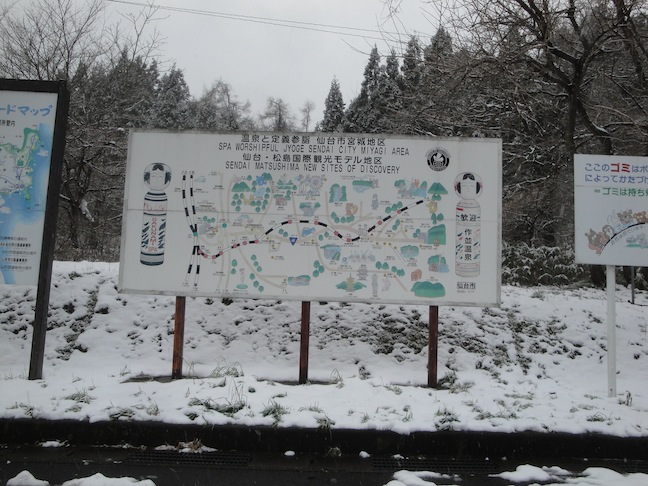 Once again we got on the Tohoku Expressway and had a smooth drive north through Ibaraki Prefecture, Fukushima Prefecture, and into Miyagi Prefecture which I'm starting to realize is, in terms of sheer numbers of kokeshi makers, the heart of the traditional kokeshi world. Using our trusty iPad we navigated to the Sakunami Onsen exit and easily found the national road into the mountains. As soon as we started going up in elevation the snow flurries began, so we had already started meeting one of our three objectives: snow. I was not concerned mind you -- we had purchased tire chains just in case and thus were well prepared for the white stuff.
 Alright, now to the kokeshi part of the tale. In Sakunami Onsen, home of the Sakunami-type kokeshi 作並系こけし, there remains just one kokeshi maker, Mr. Hiraga Teruyuki 平賀輝幸さん. A true gentleman kokeshi maker, Mr. Hiraga works out of the same old wooden building where his father and grandfather created their kokeshis, and it was just a few minutes drive up the hill from our hotel. I have a kokeshi book from 1961 that shows a photo of the outside of the shop, and by God it hasn't changed one bit in fifty years!


