Sunday, November 25, 2012

All Japan Kokeshi Festival 2012 part 7 全国こけし祭り 2012 第7

Festival revelers enjoying the stalls.
The night of September 1st was the actual festival 祭り in downtown Naruko Onsen. That is, this was the event where people put on their yukata 浴衣 (cotton summer kimono), bought food from vendors, watched a parade with dancers and a portable Shinto shrine 御神輿, and then gathered at the town square for music, singing, dancing, and a taiko drum show. When we went last year it was in the middle of a typhoon, and the fun was basically ruined by a tremendous downpour. This year, however, we had absolutely perfect weather so the show went on. Now, keep in mind that this was a kokeshi festival, so look closely at the photos below and you'll notice that this is a festival that is truly unique within Japan. I think you will agree that this was an amazing kokeshi adventure.
The parade through downtown Naruko begins!
These girls got things started. I presume that they represented the onsens based on what they're carrying.
Next came the giant kokeshis which were real crowd pleasers. Look! They have feet! 
There was one for each traditional kokeshi style.


Next came the dancers. Look closely at the pattern on their yukatas.


This truck with the drumming girls came next. The sign on the side says (from right to left, top to bottom) "58th National Kokeshi Festival: Celebration, Naruko Dance Mando Omikoshi Parade."
These kids are carrying what appears to be a kokeshi-mikoshi. Interesting.
A view of the end of the parade.
When we got to the city square a few of the large kokeshis were milling about.
The taiko drum show -- awesome!
The parade dancers showed up too. Here's a close up of their yukata.

The main stage.
These little girls gave a really terrific stage show. It had nothing to do with kokeshis, but was still lots of fun.

A local dance group.
Next blog: Our final day in Naruko.

All Japan Kokeshi Festival 2012 part 6 全国こけし祭り 2012 第6

After our visit up the mountain above Naruko Onsen we decided to pay a visit to the Japan Kokeshi Museum 日本こけし館, located just a few minutes from Naruko. We didn't go last year since I think we had already had seen too many kokeshis by that point (yes, that is actually possible), but there was a charity kokeshi auction going on there so we decided to see what it was about.
We've been to a few other kokeshi museums in Tohoku and this one was really no different. It had the usual vast kokeshi collection, a gift shop, a hands-on area, a local craftsman's corner, and historical exhibits. Overall, it's a pretty interesting place and highly recommended if you're in the Naruko area. Out front there is a giant Naruko kokeshi in front of the main building, and there was also a small Shinto shrine for the kokeshi makers which was pretty interesting.

Giant kokeshi with a 9-year old child for size reference.
Kokeshi Shinto shrine.
Inside the shrine.
Entrance to the museum.
The main hall. It was pretty busy when we were visiting.
A local craftsman at work -- I didn't catch his name.
This is a hand powered lathe, as opposed to a foot-powered one. There was a color video running showing an old lady pulling back and forth on those rings while her husband worked the wood. This was a real surprise, and it showed what a rough life the kokeshi makers used to have.
The hands-on area.
The gift shop. For some reason they wouldn't let me take any pictures inside. Oh well.
A small part of the kokeshi collection.
Another view.
More kokeshis.
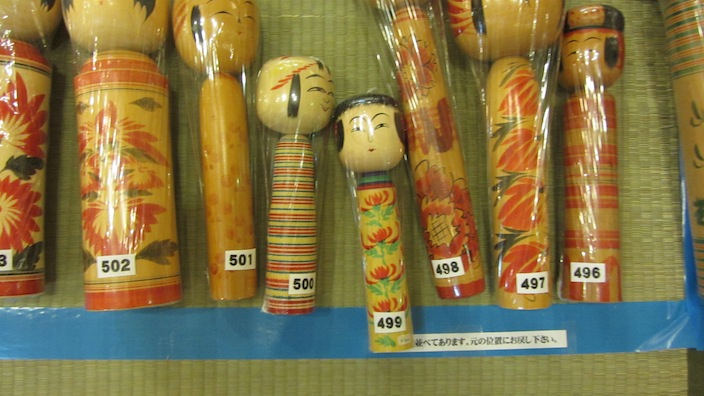
As I mentioned above the real reason we went to the Japan Kokeshi Musuem was to see the charity auction. I'm not sure what the charity was for, but I can say how the system worked. There were hundreds and hundreds of used kokeshis in the viewing room, all of which were wrapped in plastic and tended to be in nice condition. Each kokeshi had a number, and if you found one you liked you filled out a form with your name and address with the number and said what you would be willing to pay for it. Once the viewing was over the slips of paper were gathered, and whoever had offered the highest amount for a particular kokeshi was the winner. The charity officials presumably notified people throughout Japan about their win, cash was exchanged, and the kokeshis were sent out (Naoko won some small Yamagata-style 山形系 kokeshis by Mr. Abe Shin'ya 阿部進矢さん). The way the kokeshis were laid out was really an amazing spectacle, and overall this was a good opportunity to pick up rare and unusual kokeshis for a good price. Plus, it aided a charity!
For those of you who don't read Japanese the sign says in my awkward translation "Second Revival Charity Auction Bargain Sale Floor".
Some nice Abe-family kokeshis. The event was so overwhelming that we didn't bid on them.
A ground-level view of some of the kokeshis. It was a tatami room, so we had to take off our shoes.
Another view.
Small kokeshis and Darumas. Naoko successfully bid on some of these.
A close-up view of a few of the kokeshis.
Naoko and the girls being mesmerized by the charity kokeshis. 
Yet another view.
After spending about an hour at the museum we went outside and enjoyed the grounds and the view from the hilltop on which the museums sits. We were having perfect, late summer weather as you can see in the photos below. After that we drove back to the hotel past some closed kokeshi shops in order to get ready for the big kokeshi Festival parade to be held later in the evening. I'll discuss that amazing event in the next blog.
The view of the valley from the museum grounds.
The sign for Japan Kokeshi Museum. 
A closed kokeshi shop.
Another closed kokeshi shop.
One of the signs on the main road through Naruko, letting drivers know they're in kokeshi land.

Saturday, October 27, 2012

All Japan Kokeshi Festival 2012 part 5 全国こけし祭り 2012 第5

The Kakizawa Kokeshi Shop
After we had enough of the first part of the kokeshi festival we decided to go drive around and see the beautiful area above Naruko Onsen. Of course the reason there's an onsen is that the town basically sits on top of a volcano. I don't think it's active, but in Japan who knows?
Naoko and I tend to like to replicate elements of previous trips, and like last year we once again stopped  at the Kakizawa 柿澤 family kokeshi shop on the way up the hill. It's a really nice shop, and the Naruko-style kokeshis of 72-year old Mr. Kakizawa Koretaka 柿澤是隆, his wife Mariko 眞里子, and son Yoshinobu 是伸 are absolutely exquisite. Oddly, like last year we went in, were offered tea and pickled vegetables, perused the kokeshis, made some purchases, and then when Naoko drew a slip of paper for the chance to win something she won another beautiful full-size Kakizawa kokeshi. That's exactly what happened last year too!
Naoko is chatting with the elder Mr. Kakizawa. The kokeshi down on the left next to the fan is the one that Naoko won. 
Inside the shop with all those beautiful kokeshis. That's my father-in-law in the middle sitting patiently -- he was a good sport as we dragged him throughout kokeshi-land.
Some standard Kakizawa kokeshis, and some Hina kokeshis as well.
Look Mom. I won a kokeshi!
After saying goodbye to Mr. and Mrs. Kakizawa with our bag full of kokeshis we continued up the mountain and eventually arrived at a small, bright blue crater lake called Katanuma 潟沼. We stopped here last year of course, and it is so beautiful, and so interesting geologically that I will go to this lake every time we visit Naruko.
Katanuma, a small crater lake in the hills above Naruko Onsen. We had had really nice weather when we got to the lake.
It was worth going up to the lake just to see the steam vents like this.
Here's a close up of a steam vent covered with sulfer. It's not a cave -- just a small hole.
As I like to point out, kokeshi-themed signs and symbols can be found throughout kokeshi towns such as Naruko. The following pictures show this nicely.
On the way back down the hill we crossed the river and I spotted this road sign and bridge.

I'm pretty sure this represents a kokeshi head.
I also found this old, decaying phone booth with a giant kokeshi head on top. It would probably get more attention if people still used public phones.

Next blog: The Naruko Kokeshi Museum!