Tuesday, April 30, 2013

April Tokyo Kokeshi Friends Meeting 4月東京こけし友の会

The last Sunday of April was the monthly Kokeshi Friends meeting in the Kanda section of Tokyo, so Naoko and I once again headed downtown to see our kokeshi comrades and learn more about our favorite wooden dolls. I'll let the pictures below tell the story of a great day!
Outside the Kanda train station 神田駅.
We had lunch at this Chinese restaurant before the meeting. NOT recommended.
We arrived about 30 minutes before the meeting started and received numbers 56 and 57 for the kokeshi raffle. The room was already packed with anxious kokeshi fans.
In fact it was so packed that we were in the last row of chairs at the very back of the room.
We heard a very nice lecture about these Togatta kokeshis 遠刈田系こけし, and how the craftsman's style evloved over the decades.
Some of the special kokeshis available either for bidding or a drawing. I'm not sure which was which, but for some of them there was a minimum price and whoever had the highest bid won. For the others, one's name was drawn from a box and that person could then purchase the kokeshi that he or she wanted.
Naoko wanted this nice Tsugaru kokeshi 津軽系こけし by Mr. Kon Akira 今晃さん from Aomori Prefecture, but by the time her name was drawn someone else had already gotten it. Too bad -- Mr. Kon's work is awesome and hard to get! 
More of the kokeshis up for bid.
There weren't any new kokeshis at this meeting, but there was a great variety of used kokeshis on the raffle table.
Another view of the raffle kokeshis.

Naoko and I liked this Nambu kokeshi 南部系こけし (right), but apparently someone else did too since it was gone by the time our numbers were called.


I got this little Abe kokeshi during my turn. 600 yen -- not bad.


Naoko got this beautiful Sakunami kokeshi 作並系こけし by the late Mr. Shoji Suzuki 鈴木昭二さん.
Waiting for the train home on the Yamanote Line. Kokeshi Adventure complete!

Saturday, April 27, 2013

New Kokeshis 新しいこけし

A couple of weeks ago Naoko, the girls and I took my parents who were visiting from America up to Naruko Onsen for a kokeshi adventure. We had a great two days and saw lots of kokeshis that I hope to talk about in some upcoming blogs. Meanwhile, I thought I'd start off by showing a couple of new kokeshis that we found at the Kakizawa family kokeshi shop on the mountain above the Naruko Onsen village. I think you will agree that these three little guys by Mr. Kakizawa Yoshinobu are really innovative and amazingly cute.
Here we see one of Yoshinobu's "child" kokeshis that's looking up rather than straight ahead. It's about 8 centimeters, and is absolutely beautiful with its cherry blossom pattern and dropping petals. The other two are obviously tiny and wonderfully crafted.
Here's a close up of the two small ones. Yes, those are acorn caps on their heads. According to Yoshinobu his son suggested this idea, and he crafted the kokeshis so they could wear these little hats. Naoko fell in love with them immediately.
Here's another view of the child kokeshi. This is genius. We have one more of this style that we got at another time.

Sunday, April 7, 2013

Spring Kokeshi 春のこけし

Seasonal kokeshis are rare, but we happen to have one by Naruko kokeshi 鳴子系こけし craftsman Mr. Kakizawa Yoshinobu 柿澤是伸さん. It's still very much a traditional kokeshi, but with a nice spring theme. Naoko recently put this one out for individual display, so I thought I'd share it. From what I've seen the young generation of kokeshi craftsmen tend to branch off in creative directions like this. A really beautiful piece!  

Yoshinobu is good with faces. Note the slight hint of blush on the cheeks. The type of wood is darker -- maybe maple, or pear?
Individually painted flowers as instead of stripes. The base is purple with a very pleasant gradation.
Also interesting is the back which has leafs instead of flowers. I can imagine that this piece took more time than usual to create.
Another shot of the head. The pattern on the head gives away that it's a Naruko kokeshi.

Sunday, March 17, 2013

December 2012 Adventure 7 12月の冒険7

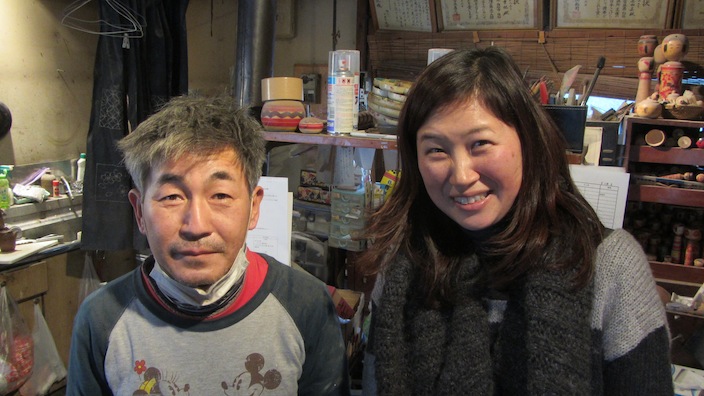
While at the Yajiro Kokeshi Village 弥次郎こけし村 in the hills outside of Shiroishi City we visited the workshop of Niiyama Yoshinori 新山吉紀さん and Mayumi 真由美さん, two expert Yajiro craftsmen. We had called the workshop ahead of time, not knowing that we would end up at the Kokeshi Village, so all of this was a nice surprise. On this day Mrs. Niiyama was out, so we spent about an hour with just Mr. Niiyama who gave us a good deal of information on his recent adventure as a kokeshi ambassador in Paris, and about various other kokeshi makers. The Kiboko Workshop 工房きぼこ, as it's called, is a small, cozy, traditional Japanese building located on the grounds of the Kokeshi Village along with other similar workshops.

The workshop.
The front door into the Kiboko Workshop.
As we entered Mr. Niiyama welcomed us and prepared some tea, a kokeshi shop tradition that I really like. Of course the workshop was also the showroom, if we could call it that, and we were greeted by a couple of shelves of the Niiyama's beautiful kokeshis as soon as we entered. Right next to those was their personal kokeshi collection, and I'm always happy to see when kokeshi makers have an interest in the work of other craftsmen. 

The new kokeshis for sale. Lots of variety.
A close up. The Niiyama's craftsmanship is superb as you can see.
Their personal kokeshi collection.
Another view of those kokeshis, which could use a good dusting. Naoko and I liked that rare Nambu kokeshi 南部系こけし, the big white one behind the kokeshi with the rings on its arms.
Naoko and Mr. Niiyama chatted about various things for a while as I took photos of kokeshis and tried to keep an eye on the girls who were still rock climbing and playing in the snow and ice outside. Eventually the girls came in to warm up and Mr. Niiyama had them try some sawdust. What I mean by "try" is that he had them eat some sawdust which the girls did reluctantly. I didn't recall why he had them taste some of the sawdust, but was fascinated by the whole thing. Naoko told me later that he was explaining to the kids that the wood he was using was the same as that used for disposable chopsticks. I must say that Mr. Niiyama is the first kokeshi maker we've met who has offered sawdust for tasting. After that Mr. Niiyama gave a demonstration on the lathe, whipping out a fully completed top in about 2-3 minutes. It was amazing. He took a chunk of raw wood, lathed it down into a top shape, gave it some paint, and handed it to Emily in almost no time at all. 
Sawdust? No thanks.
The girls are trying some special edible sawdust.
Here's Naoko documenting Mr. Niiyama at work on his lathe. He's making a top.
And voila! A top.
Anyway, we came for kokeshis but it was tough to pick out the ones we wanted, but in the end we chose two beautiful traditional Yajiros, one by Yoshinori and one by Mayumi. Naoko also found a small kokeshi with a removeable head that becomes a top. Those are always fun.
Our new kokeshis. I especially like the one with the squarish head in the center by Mrs. Niiyama.
Naoko and Mr. Niiyama upon departing.
Overall, this was really good mini-adventure that topped off a fantastic trip up to Tohoku. It was a great way to develop an appreciation of one of the kokeshi families that I know very little about.

Sunday, March 10, 2013

December 2012 Adventure 6 12月の冒険6

Continuing on our big kokeshi adventure from last December, after leaving the Sakunami and Akiu area we headed south on the Tohoku Expressway for about 30 minutes until getting off at the exit for Shiroishi City (白石市) in southernmost Miyagi Prefecture, right on the border with Fukushima. Destination: the Yajiro Kokeshi Village 弥次郎こけし村 in the hills west of Shiroishi. We were having a cold but pleasant winter day with good views of the mountains, and we even saw a flock of Russian swans on the side of the road. Thanks to our iPad's Google map and its directions we had no problem finding our way through the generally sign-less countryside, at least to a point. Word to my fellow foreigners -- if you come here you will get lost without a proper map and directions!
Countryside.
Mountains.
Swans.
As we puttered along Naoko and I searched for road signs that would lead us to the Yajiro homeland, and after a while finally spotted one that let us know we were indeed on the right path. At this point we were starting to go up the side of the mountain, and although there was some snow on the side of the road it had been warm enough that most of the ice and snow had melted. That was a good thing since we were snaking up and a down a narrow and precarious mountain road. We finally came to a kokeshi shop with a couple of large kokeshis out front, but it was shut tight and looked like it had seen much better days in the past. Hmmm. We crossed a kokeshi bridge of the sort that all kokeshi towns seem to have, and the Yajiro kokeshis at each end were freshly painted. This confirmed that this was likely a thriving kokeshi community. After that we went through Yajiro (the bus stop sign), a small settlement that was made up of a few closed kokeshi shops. Not a good omen it seemed, but there were more and more signs for various kokeshi workshops, so we were definitely in a kokeshi-dominated area. But where were the kokeshi makers, and where was the Yajiro Kokeshi Village? We continued to drive up the hill with Mt. Zao, home of another kokeshi tradition, right in front of our eyes. At that point it became clear that this general area, connecting Naruko, Sakunami, Akiu, Togatta, Zao, Yamagata, and Yajiro is definitely a kind of kokeshi ground zero. Wow.
The first shop we encountered was shuttered.

Ah, a kokeshi bridge. Always a good sign that kokeshis are nearby.
Fresh paint -- another good sign.
Another closed kokeshi shop.

As we drove along admiring Mt. Zao we went around a corner and up a sharp incline, and at the top was the Kokeshi Village. Finally. And, hurray! The Yajiro Kokeshi Mura main building is definitely distinctive, being perfectly circular and resembling a gigantic wooden yurt. There was no entrance fee, so we strolled right in. The inside is very pleasant with exposed wooden beams on the second floor, and an open courtyard in the center. There were some rooms for workshops, a small restaurant of some sort, and a very nice gift shop with lots and lots of (mainly) Yajiro-type kokeshis 弥次郎系こけし and kokeshi souvenirs. There weren't very many people though, guests or workers, so we basically had the place to ourselves. However, rather than do some shopping at this point we heading downstairs and out back to the "village" area; i.e., where the kokeshi makers have their workshops.  
Walking to the main building with Mt. Zao in the background.


Yajiro kokeshis for sale.

The girls playing with tops.
A small display of Yajiro kokeshis on the building's first floor.
Mail box.
The back side of the main building. Those rocks are pretty large and became a good climbing spot for the girls.
Below are a few of the kokeshi workshops in a circle behind the main building.


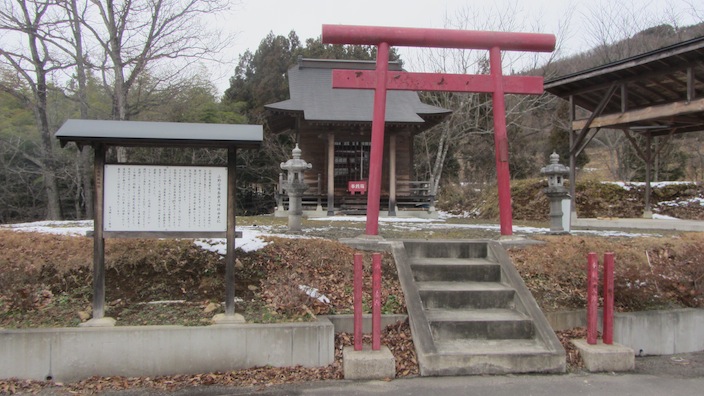
By the way, there was even a Kokeshi Shrine where there is apparently an annual ceremony of some sort for kokeshi makers. That must be pretty interesting to see.

Next blog: A visit with one of the kokeshi makers!