Saturday, April 30, 2011

Kokeshis and an Earthquake

Just after the earthquake. It could have been worse.
Traditional kokeshis are, by design, top heavy. Not that kokeshi makers necessarily produce them to be top heavy, but with their typically large round heads (the center of gravity) and long, thin cylindrical bodies, even on a normal day these things topple over pretty easily. As the world knows, on 11 March 2011 Tokyo and all of northern Honshu island suffered a massive earthquake. Locally we felt it as a strong five (Japanese scale), which made our 9-story apartment building wobble like it was made out of rubber. It was absolutely amazing! A few of our kokeshi dolls fell over, though Naoko -- true kokeshi enthusiast that she is -- had the presence of mind to lay a couple of the big ones down before they had a chance to fall. We can only imagine what the kokeshi makers' workshops up in Tohoku looked like after the shaking stopped. After all, Iwate, Miyagi, and Fukushima Prefectures, hardest hit by the quake, are the heart of the traditional kokeshi world. It turns out, though, that toppled kokeshis haven't been their biggest problem. Apart from the incessant aftershocks that have made fine detail work difficult tourism to that part of Japan has understandably dried up, and since kokeshi makers are very reliant on tourists for their trade times are definitely tough. Naoko follows a number of Japanese blogs about traditional kokeshis, and along with their fellow countrymen the craftsmen are keeping a stiff upper lip. Nonetheless, this must be an extremely difficult time for them.  
Naoko assisted some of these into their down position before we left the building.

Monday, March 7, 2011

Kijidokoro Sato Kokeshi 木地処さとうこけし

Welcome to Iwaki
On the weeked of 5-6 March we drove north to Fukushima Prefecture (福島県) in southernmost Tohoku, the land of kokeshis! Our quest was the Kijidokoro Sato Kokeshi (木地処さとうこけし) studio and workshop in Iwaki City (いわき市), an old coal mining area and port on the Pacific Ocean.
Because we expected a long drive we were on the road by 7:30 am, picked up my father-in-law on the way, and got on the Joban Highway (常磐高速道路) by about 9:15 am. Yes, it took over 1.5 hours to actually get to the highway -- that's Tokyo city driving for you. In absolutely perfect weather we headed north from the Oizumi Interchange, encountering some light traffic at first, and were at the Iwaki exit by about 11:30. It took about another thirty minutes to find the kokeshi workshop which was a house located in a semi-residential, semi-agricultural area in the city suburbs. Note: Non-Japanese beware. This is another place that would be impossible to find without Japanese-language reading ability.
Giant kokeshis. Much to everyone's horror I knocked over the one on the right. Fortunately, no harm done!
The workshop as seen from the street.
Crafting kokeshis.
Kijidokoro Kokeshi is a branch of the Fukushima Prefecture traditional kokeshi style called Yajiro (弥治郎), named after the Yajiro Onsen (hot spring) area in the north Fukushima mountains. The Sato family, the proprietors, are part of a Yajiro kokeshi-making familial line on Mrs. Sato's side. Even though they are no longer making their kokeshis in Yajiro there is no doubt that Kijidokoro is part of that tradition, though perhaps they might be called the Iwaki branch. Yajiro kokeshis are typically identified by the concentric circles on the top of the head, which in the case the Kichidokoro ones. They also tend to have very whimsical faces that are surprisingly different from other kokeshi types.
As with other kokeshi workshops we have visited, there was a chance to watch kokeshis being made, and on this day one of the sons was at the lathe making kokeshi bodies. Mr. and Mrs. Sato also make kokeshis, as does their other son. It is always fun to see kokeshis being born, as it were.
In the studio.
The Kijidokoro Kokeshi studio is really just the Sato's living room, which makes it nice and homey.
We were welcomed right in for some tea and cookies, to talk kokeshis, and to see what they had to offer. Dozens of nicely arranged kokeshis adorned the studio, organized by whichever family member had made them. Once again we were overwhelmed by the choices offered, especially since each was so beautiful. The Satos make a wide variety of kekeshi sizes, from the absolutely tiny to enormous. I liked the huge ones (about 1.5 feet high), but at 35,000 yen each I'll have to save my money.

Tiny kokeshis.
Kokeshi kendamas.
Naoko was drawn to the diminutive kokeshis, which Mr. Sato sells as small boxed sets for 5,000 yen. They also make the tiny ones into Japanese seals, which according to Mr. Sato have been very popular. Anyway, one can see just how small they are in the picture above, dwarfed as they are by a Han Solo Battle of Hoth action figure. Those are all hand-lathed and hand-painted. Exquisite! The Satos also make and sell wooden toys (tops, kendama), and kokeshi-themed items such as cell-phone straps and magnets. Overall nothing was cheap, but these are hand-made crafts from Japan so that is to be expected.
Standard kokeshis that are now part of our collection.
Besides a box of three tiny kokeshis, we bought three standard-sized ones that are good examples of what the Satos produce. The photo clearly shows the head rings that identify a Yajiro kokeshi, but I would like to think that these are, at least in some small way, unique to Iwaki.
Telltale concentric rings of a Yajiro kokeshi.
In sum, our kokeshi aventures continue!
Variety.
More.

Small, but not the tiniest. 
Freshly painted kokeshis that will become seals.

Saturday, February 26, 2011

Usaburo Kokeshi

Our first view of Usaburo Kokeshi. 
Our very first kokeshi adventure took place on January 15th, 2011 when, on a whim, we got on the highway and headed due north of our home to Gunma Prefecture in central Honshu. We had a coupon for a kokeshi factory of some sort -- Usaburo Kokeshi (卯三郎こけし) -- located in Shibukawa City (渋川市), and it said that kids could make their own kokeshis. Why not go there we thought? After meandering around on the side of what must have once been a volcano we finally found the place, and what a nice surprise it turned out to be! Let's just say that anyone who like kokeshis will love this place.
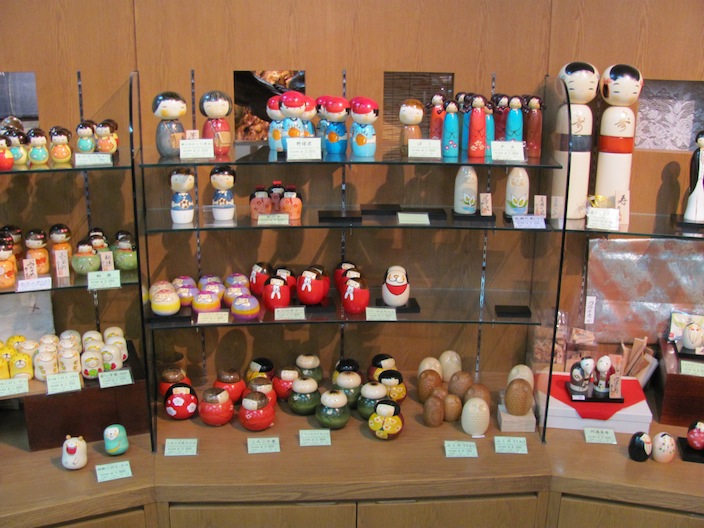
Variety of kokeshis for sale.
The essence of cuteness?
Every one of the kokeshis here is a Christmas kokeshi. 
As I've explained in previous posts there are two different types of kokeshis: Traditional kokeshis, which come from northeastern Japan, and modern kokeshis which can come from anywhere in Japan, but are especially strong in Gunma Prefecture. Usaburo Kokeshi makes modern kokeshis of all types, from miniature ball-shaped ones, to the usual girl kokeshis, wedding kokeshis, and even creative sculptures where faces appear wood-nymph like out of small logs. One thing I can say with certainty is that Usaburo is especially adept at making kokeshis that are, well, cute. After seeing the amazing variety of kokeshis in the large retail area I was really struck by what can be done with just a small piece of wood.  
More kokeshis.
Painting kokeshis.
The wood-working building.
Working on a lathe.
It quickly becomes clear that Usaburo Kokeshi is a full-scale factory rather than an artisan's shop. There are plenty of employees both in the wood-working area and paint shop, and they are making many of the same kokeshi as can be seen in the photos. The painters, who also make patterns and designs on the wood using using a burning device, are located inside the retail area and it is easy to watch them work. The wood shop is next door and is fully accessible to visitors. We walked through the shop and observed craftspeople at work on their lathes, and then through the main factory area where there were bins full of various unpainted kokeshi parts and piles of lumber waiting to become kokeshi parts. For those who enjoy seeing how things are made, such as I do, this was a treat. To be honest I am simply in awe of this kind of Japanese creativity. The people in this country have an inventiveness and eye for design that seems infinitely more advanced than that of the U.S. Also important is Usaburo and the other kokeshi makers actually make their kokeshis -- no outsourcing to China or some other third world country whose laborers do not understand what they are making. That in itself is of great value.
In the factory.

There is also a free museum on the second floor of the main building, which is an ode to the Usaburo Kokeshi tradition. The 
Industrial kokeshi making.
 beginnings appear to have been humble, as the company made small, fun commemorative wooden figures during the 1950s and 1960s that evolved into today's modern kokeshis. Unfortunately there is a no-photography policy in the museum or I would show some photos, but suffice it say that it was worth the visit. On a side note, Naoko and I saw two of our kokeshis in the museum, which means that we own museum pieces! More on our musuem kokeshis in a future post.
If you like modern kokeshis, then Usaburo Kokeshi is a must visit, and there are many reasonably priced pieces available, as well as more expensive and special ones too. Here is a link to the English-language web site if interested. To sweeten the deal there is a wonderful onsen (hot bath) called Ikaho Onsen (伊香保温泉) right up the hill from Usabaro Kokeshi, which we spent an hour in after our taxing but delightful day at the kokeshi factory. Lucky us since it was snowing that evening. The only thing that was a disappointment was that Ikaho did not sell special kokeshis. After all, the Japanese kokeshi tradition likely started as souvenirs for sale at onsens in northeastern Japan.
Kokeshis being born.
Making kokeshi parts.
Overall, this was not just another successful kokeshi adventure. It was the adventure that got us started on our quest to visit Japan's kokeshi makers, and learn as much as we can about this wonderful Japanese tradition. 
These works of art are creative kokeshis. The one on the right was 40,000 yen.
More creative kokeshis.
Daruma kokeshis.
Celebration kokeshis -- Add a message and give as a present.
These pieces of wood will become kokeshis.
Kokeshi bodies.
It's amazing what can be done with a small piece of wood.


Male and female bunny kokeshis.
Wedding kokeshis. 
Baskets of mini kokeshis.
Usaburo also sells spoons.
Here is where you can paint your own kokeshi.
Giant kokeshi outside the main building.

Wednesday, February 23, 2011

Are These Kokeshis?

When we went to the All Gunma Kokeshi Concours on February 12th, we discovered these two amazing pieces among the kokeshis for sale. The difficult part is, how should they be categorized? The one on the left is a kendama (剣玉), a traditional Japanese toy. Because it has a face and an oversized head it is somewhat different than traditional kendamas that typically have just a proportional red round ball for a head. The other example looks something like a squat traditional kokeshi, but it is actually a holder for whatever you would like. We use this one to hold plastic rice scoops, but one could use it for pencils and pens, chopsticks, sunglasses, small sheets of paper, screwdrivers, etc. Is it a kokeshi? I don't know. The man who made it also makes modern kokeshis, so I'll ask him what he calls it if we meet him in the future. By the way, the price for the kendama was about 1,500 yen, while the hollow kokeshi was 500 yen. For a handmade, hand-painted craft from Japan, this was an absolute bargain. Why didn't we get more of them?

Monday, February 21, 2011

A Traditional Kokeshi Shop

As much as Naoko and I would prefer to visit kokeshi workshops, meet the creators, and purchase kokeshis in their native environment, we are also more than happy to visit shops that just sell them. In previous posts I have described our trips to quasi-kokeshi shops (Tokyo Kokeshi, Kokeshika) that also sell non-kokeshi items. Those were lots of fun. However, on February 19th we sought out a traditional kokeshi-only shop named Kiboko (木ぼこ) north of Machida City (町田市) near Tsurukawa (鶴川), about 15 miles southeast of our home. As with all of these trips within the Kanto Plain it took forever to get there because of the roads. Nevertheless, it was well worth our time.
These are all for sale.
"Is this a good one?"
For Americans and other foreigners who cannot read Japanese I would say going to this shop without a guide would be out of the question: Kiboko is on the first floor of a private house located in a maze-like residential area in the middle of nowhere. Fortunately, we happened to notice the shop's tiny sign while driving blindly around the neighborhood. It took a few minutes for the owner to open up after we called him on the comm-link, but once inside it was truly traditional-kokeshi heaven. Basically the shop is like a small museum where everything is for sale, though the kokeshis are definitely not cheap. According to Kiboko's owner it is one of only two of its kind in Japan. There were no modern kokeshis to be seen, so I would say it is really a place for serious traditional kokeshi collectors, or those hoping to be serious collectors! The shop owner, a connoisseur himself, was a wealth of information and was happy to answer all of our questions and talk about kokeshis.
Naoko's new kokeshis. They looked her in the eye and said "buy me."
Kiboko sells both new and antique kokeshis. To the best of my knowledge the shop has representative pieces from all major traditional kokeshi types, from Naruko (鳴子) to Tsuchiyu (土湯) to Togatta (遠刈田), in all shapes and sizes. All were delightful, but one group that I found to be striking was those of a branch of the Tsugaru (津軽) type from Aomori Prefecture. The colors on these primitive-looking works are simple and earthy, and the faces are jovial and childlike. While I am not yet an expert on these things, I cannot help but think that this is the way kokeshis from Tsugaru might have looked back in the 19th century.
These are also for sale.
Naturally, since this was a kokeshi adventure we could not leave the shop without bringing something home with us. While our friends who had joined us on the adventure were able to run into the shop and quickly pick out a couple of kokeshis to send back to America as presents, we couldn't do that. Purchasing kokeshis is a process that takes time. Moreover, Naoko read somewhere that a kokeshi will look at you and tell you to buy it (maybe like a puppy in a pet store), and sure enough there was a tiny Togatta type that Naoko felt was saying "bring me home." She also found a giant Yamagata (山形) type, about 1.5 feet high, that called out to Naoko's maternal kokeshi instincts. Naturally we could have bought many more, but did not because we have decided that it would be preferable to get the kokeshis directly from the artisans up in Tohoku (northeastern Japan) when we go there later this year.


Tsugaru kokeshis. Somehow, I found these to be striking.

Yajiro (弥治郎) kokeshis.
Tsuchiyu (土湯) kokeshis. 
Antique kokeshis.