Friday, October 7, 2016

A Black and White Yajiro Kokeshi

In the previous blog entry I discussed Naoko's trip to Japan and her one kokeshi adventure in downtown Tokyo. Today I am going to talk about a beautiful black and white Yajiro kokeshi 弥治郎系こけし by Mr. Niiyama Yoshinori 新山吉紀さん that Naoko purchased. We met Mr. Niiyama back in December 2012 (it was very cold that day) at his workshop located on the grounds of the Yajiro Kokeshi Village in Shiroishi City in southern Miyagi Prefecture, so that is a pleasant connection with this kokeshi.
Black and white kokeshis are not all that common, which might be one reason why I like them. I especially like the fact that Mr. Niiyama made the hair ribbons red, the only bit of color on this piece other than the mouth. As we can see this is actually a very simple design with some thin black lines along with thicker gray lines, all of which serve to accentuate the shape of the wood. The doll's height is about four inches, or ten centimeters.
Looking down from the top we can see the "snake eye" pattern on the crown, but this would usually be painted in bright colors on a typical Yajiro kokeshi.
The next image is a close up of the face where we can see a wisp of hair in the middle, the collar of the kimono, the slight nose, the sparing use of red, and the delicate brush work for the locks of hair that frame the face. In my opinion this is a very well done Yajiro kokeshi.
Finally, turning the kokeshi over we can see Mr. Niiyama's stylized signature. I must say that Naoko found an excellent piece for our collection.

Wednesday, October 5, 2016

Some New Kokeshis

This summer Naoko and the girls went to Japan, and of course the trip included a kokeshi adventure. On 17 June Naoko hopped on the train to Uguisudani Station in downtown Tokyo to attend the 5th Shitaya Kokeshi Festival 第5回 下谷こけし祭り. The event was held at a cool shop called Hikimono Gangu Negishi 挽物玩具ねぎし which is owned by a kokeshi collector whom we know. Naoko knew about the festival thanks to a post card that came a few weeks before departing.
The back of the post card for the festival.
The front of the post card for the festival.
The platform sign at Uguisudani Station.
Unfortunately photography wasn't allowed inside the shop, but Naoko reported that it was a successful event with lots of people. She also saw some of our friends from the Tokyo Kokeshi Tomo no Kai, and was even interviewed for NHK TV (though Naoko didn't make the air -- oh well). Six kokeshi craftsmen were on hand selling their wonderful work, and Naoko brought nine pieces back to California as shown in the photo below. I wish I could have been there too.
Our nine new pieces: Seven kokeshis and two Darumas.
The craftsmen who came to Tokyo for the festival were Honma Naoko 本間直子さん, Niiyama Mayumi 新山真由美さん, Niiyama Yoshinori 新山吉紀さん, Onuma Hideaki 大沼秀顕さん, Abe Kunitoshi 阿部国, and Hiraga Teruyuki 平賀輝幸さん. I'll talk about of the kokeshis that Naoko bought in the next few blog posts.

Tuesday, September 27, 2016

Fall through Winter Kokeshi Festivals 秋から冬へのこけし祭

A reader wrote asking about this year's Michinoku Kokeshi Festival みちのくこけしまつり in Yamagata City, and there are probably many people interested to know when and where it's occurring. This festival is considered to be one of the big three annual kokeshi festivals so it's well worth attending. The only problem is that it is not really being advertised yet, and it took me a while to find a source that provides a date and location. According to the Japan Travel and Tourism Association web site (link is Japanese language) this year's festival is December 3rd and 4th at the Yamagata Big Wing 山形ビッグウイング convention center. When my family and I attended the festival it was in October at the Nana Beans Building, so this is a change. Sorry, no poster, at least not yet. When I find out more information I'll be sure to announce it in an upcoming blog.
Meanwhile, the Tokyo Kokeshi Tomo no Kai has announced a number of upcoming kokeshi events on its web site that I would recommend checking out (Japanese language only):
http://www.tokyo-kokeshi.jp
Here are some highlights.
14-15 October 2016: The 29th Annual National Traditional Kokeshi Craftsman Festival 第29回全国伝統こけし工人フェスティバル held at the Tsugaru Kokeshi Kan 津軽こけし館 in Kuroishi City, Aomori Prefecture. It's a free event, and there is a poster available below. Click here to go to the Tsugaru Kokeshi Kan web site which has more info on this and other upcoming events.


1 October through 27 November 2016: The Cute Kokeshi Exhibit KAWAIこけし展 at the Yokohama Doll Museum in Yokohama City. This looks fantastic, and for anyone living in the Kanto area this is a great opportunity. The cost is 200 yen for adults and 100 yen for kids. Please see the poster below and click here for further details (Japanese language).


For those who can attend the above events please enjoy them for those of us outside of Japan!

Monday, September 26, 2016

Kokeshi Jidai 13 こけし時代13号

Greetings fellow kokeshi fans. I have been away from doing this blog for a while, but am back and am looking forward to discussing all things kokeshi from our home in the Bay Area, California. Meanwhile, Naoko was in Japan for the summer and observed that the traditional kokeshi world is still going strong in 2016. This is good news for the kokeshi craftsmen and everyone who loves the result of their hard work. I'll pass along more of what she saw in some upcoming blog entires.

While in Japan Naoko was also able to get the latest edition of Kokeshi Jidai magazine, which is now up to issue 13 that came out in April 2016. We missed issue 12, so we'll have to order that soon before it's sold out. Most kokeshi fans in Japan probably already have this issue, but those living in foreign countries might not know that it's available. Therefore I've provided a few images of the inside of the magazine so you'll know what to expect if you're thinking of purchasing it.
The front cover of issue 13 is actually a thin layer of real wood glued to the paper cover. Beautiful.
The focus of this issue is Hijiori kokeshis 肘折こけし from Hijiori Onsen in Yamagata Prefecture. I've always liked this kokeshi family since the lips are painted realistically making the kokeshis quite striking. As always there are plenty of articles on the kokeshi craftsmen, individual kokeshis, and local hot springs (onsens) that make me want to get back to northern Japan.


Besides the articles on kokeshi and hot baths there's an article about a couple in Finland whose folk art is inspired by kokeshis, a report on kokeshi fans in Osaka, and three articles about kokeshi collectors. I was very interested to see how others display their kokeshi collections, such as what we can see in the image above.
The back cover of issue 13.
I love Kokeshi Jidai magazine and am always happy when a new issue comes out. This issue was 2,500 yen (about $25 US) which isn't cheap, but its nearly 290 pages on high quality paper. Of course if you're an enthusiast then you'll understand why it's really a bargain.

Monday, September 14, 2015

2014 Rokuro Festival 2 2014 ろくろまつり 2

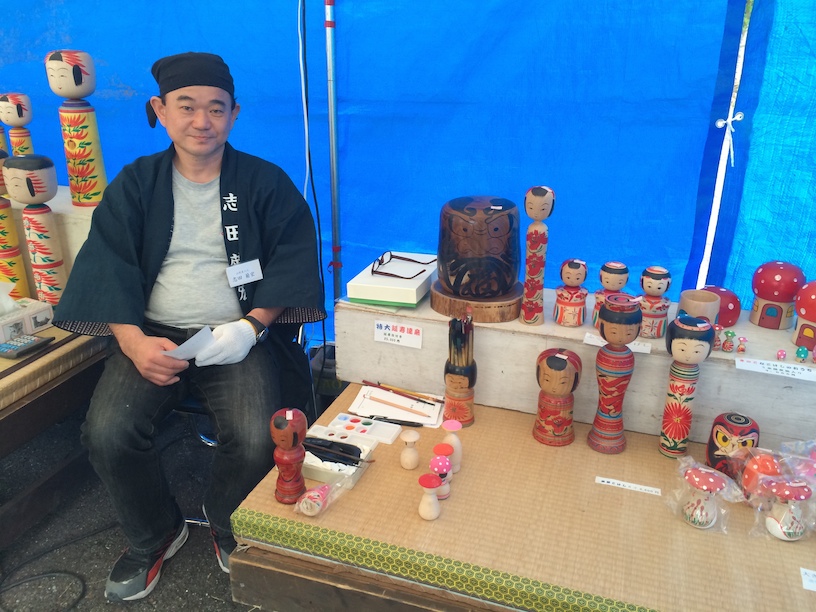
Continuing with the October 2014 Rokuro [Lathe] Festival ろくろまつり held in the Miyagi-Zao Kokeshi Kan parking lot, we parked and jumped out of the car to see what was going on. I didn't know who was going to be there (though Naoko might have), and I was happy to find that there were a number of craftsmen whom we have visited and gotten to know over the years: Ms. Honma Naoko 本間直子さん from Aomori, Mr. Hiraga Teruyuki 平賀輝幸さん from Sakunami, and Mr. Shida Kikuhiro 志田菊広さん of far western Yamagata. When we arrived there wasn't a huge selection of kokeshis compared to what we saw the previous day at the Michinoku Festival, so I think sales had been brisk on the first day. That said, there were still plenty of kokeshis available, and we of course added a few more pieces to our collection before the day was over.  
Looking at the venue. Kokeshis on the left, food on the right.
Mr. Shida chatting with Naoko and the girls.
The Rokuro, or Lathe Festival lived up to its name with a working lathe on which the craftsmen were giving demonstrations. They were also painting kokeshis, so for those who aren't able to get to the often rural homes of the kokeshi makers this was a good chance to see a variety of craftsmen at work. For instance there was a group of tourists from France while we were there, so they had picked the right place to not just buy kokeshis and meet lots of craftsmen, but also to see how they are made.
The following photos are an overview of what we saw at the event, and it was excellent. Enjoy!
Naoko and the girls taking with Mr. Hiraga.
Mr. Hiraga's kokeshis.
The mascot of the Togatta -Zao Kokeshi Kan , Zao-sama, was also seen at the event.
Some of those kokeshis are actually tiny Zao-sama kokeshis.
Rare Iwate kokeshis by Mr. Susumago Morizo.
Ms. Honma Naoko's Tsugaru kokeshis.
So that's what the Rokuro Festival looks like, and I hope we're able to get back to see it in the next few years. This year is going to be the 26th and 27th of September, so if you're in Japan or will be visiting go up to Miyagi Prefecture and spend the day at this important annual kokeshi event. In the next blog I'll take a look at the Miyagi-Zao Kokeshi Kan.

Tuesday, September 8, 2015

2015 Rokuro Matsuri Announcement

Since I'll be talking about the Rokuro Matsuri (Lathe Festival) at Toggata Onsen over the next couple of entries I might as well announce that the 2015 Rokuro Matsuri is scheduled for 26 and 27 September at the Miyagi-Zao Kokeshi Kan みやぎ蔵王こけし館. On Saturday 26 September it will run from 10 to 4, and on Sunday 27 September it goes from 10 to 3. According to the event poster below there will be twelve kokeshi craftsmen taking part -- amazing! What a great chance to meet a large number of craftsmen in one place, add numerous kokeshis to one's collection, and even visit the the Miyagi-Zao Kokeshi Kan which has free admission on those days. There's not a whole lot of information on line about this event, but I'm sure it will be great.

2014 Rokuro Festival 1 2014 ろくろまつり 1

Poster for the Rokuro Matsuri.
Following the Michinoku Kokeshi Festival on 4 October last year (2014) we spent the rest of the day in Yamagata City, which is also where we spent the night. We got up the next morning feeling refreshed, grabbed some breakfast to go at a nice bakery, and then got on the highway for the other major event that weekend -- the the 26th annual National Traditional Kokeshi Lathe Festival 全国伝統こけしろくろまつり, or Rokuro Matsuri held at the Miyagi-Zao Kokeshi Kan みやぎ蔵王こけし館 near Togatta Onsen 遠刈田温泉. Rokuro means "lathe" in Japanese, and Togatta is one of the major kokeshi homelands, so suffice it to say this festival is an important one. As I mentioned in a previous blog the Rokuro Matsuri is typically held on the exact same weekend as the Michinoku Kokeshi Festival so we were never able to make it until this year. In the next couple of entries I'll show what we saw, but I did want to point out that one reason this festival is more challenging to
attend than Michinoku is that it's only accessible by car. Furthermore, as we shall see below the route will take you on small country roads in the middle of nowhere with limited signage, so a GPS is essential. That said the payoff is worth it, and if you can make it to the Miyagi-Zao Kokeshi Kan then you can also visit the Togatta Kokeshi Village and the workshops of various kokeshi makers located in town.
Going east on the Yamagata Expressway we got off at the Miyagi-Kawasaki exit. From there it became extremely rural.
We headed due east through the mountains out of Yamagata Prefecture and into Miyagi Prefecture. Interestingly the prefectural border is actually marked in the middle of a long tunnel. As we headed back down towards sea level we exited at the Miyagi-Kawasaki exit and then found ourselves on rural prefectural roads going through rice fields and woods. Fortunately Naoko had her iPhone and trusty Google Maps, so we were pretty sure we were going the right way. If you're driving north or south on the Tohoku Expressway then get off at the Murata Interchange.
We turned at this old stone monument.
The funny thing was that after exiting the highway Google Maps had us turn onto narrow, unmarked roads, so there was some guesswork involved as to whether or not we were on the correct road. But we could sense were going in the right direction and we got to see some beautiful countryside along the way.
At one point we were driving on this 1.5-lane country road.
Early October is when the rice is ready for harvest, and Miyagi Prefecture is a big rice-producing region. As such we were treated to magnificent golden fields of ripe rice letting us know that fall was imminent.
After many turns and a pleasant drive through the countryside we finally entered Togatta via a bridge that has large kokeshis that appear to be standing guard. It is aptly named Kokeshi Bridge こけし橋. The kokeshis appeared to have been freshly painted and stood out nicely against the gray sky. Note: Once you reach this bridge you are almost at the Miyagi-Zao Kokeshi Kan.
Gateway to Togatta.
The festival being held outdoors.
By the time we arrived the festival was in full swing and since the weather was nice it was being held outside. There were a lot of cars and since the regular parking lot near the Kokeshi Kan was being used for the tents we had to park in the grace. But parking wasn't a problem and soon we were strolling up to our second major kokeshi festival in two days!
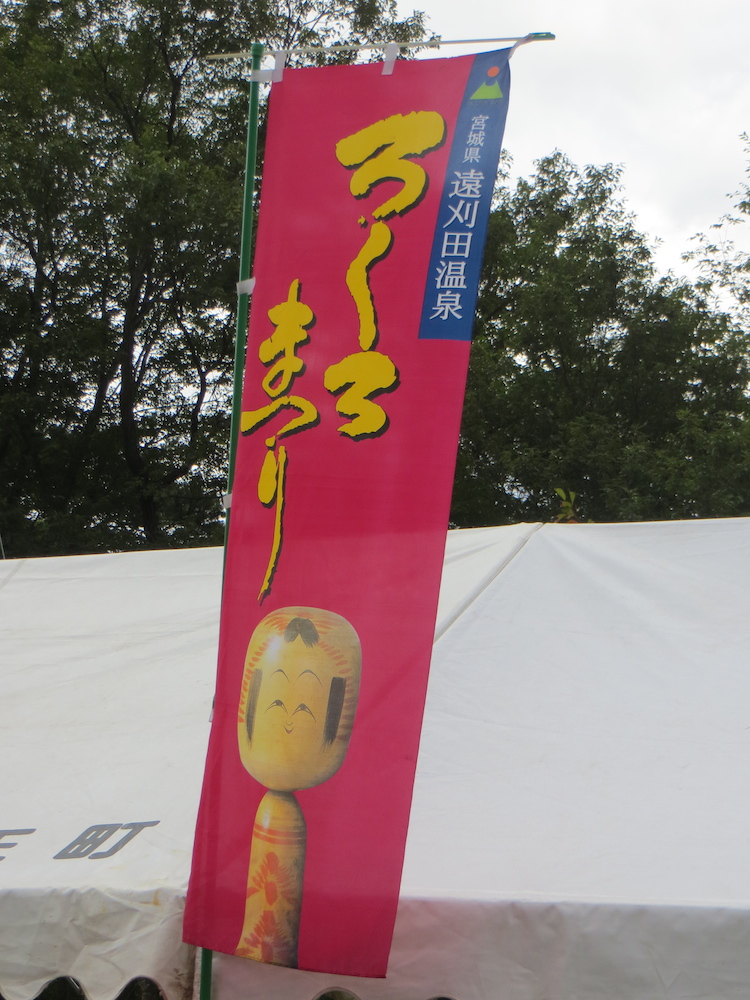
One of the festival banners.
In upcoming blogs I'll show some photos of the festival and the Kokeshi Kan.