Tuesday, June 26, 2012

Michinoku Kokeshi Festival みちのくこけしまつり

A gate into Yamagata Castle.
On Saturday, 2 October we awoke early for an event at Emily's preschool which went on for most of the morning. After that ended we got on the Tohoku Expressway for a trip north to Yamagata Prefecture, one of the most beautiful places in Japan. From Tokyo to Yamagata City it took about 5.5 hours, so we were in Yamagata City by early evening and promptly checked into our Quality Inn right near the main train station. I like this hotel since you 1) pay for the room only rather than per person, 2) it comes with a continental breakfast, and 3) it has WiFi in the room. True, at Quality Inn one doesn't get the "Japanese" experience of sleeping on a tatami mat in an old ryokan, but since we tend to go out exploring all day that really doesn't matter a whole lot. Also, the "Japanese experience" tends to be quite pricy, and I'd rather spend the money we save on, what else, kokeshis.
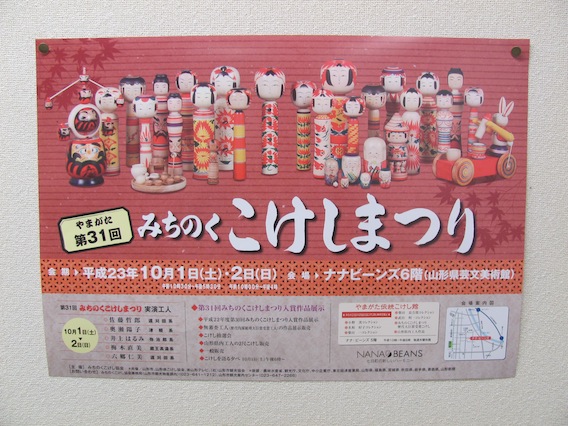
Official festival poster.
The object of this adventure was the 31st annual Michinoku Kokeshi Festival, and at the time I felt that it paled in comparison to the National Kokeshi Festival in Naruko Onsen that we had attended just one month prior. Looking at the photos and thinking about this blog though makes me realize that it was a pretty fantastic kokeshi event that was part of a really top-notch kokeshi adventure.
The festival was held in the Nana Beans Building in downtown Yamagata, and we took the scenic route to get there by walking through the Yamagata Castle ruins and on various streets. Before continuing I have to say that this walk, and a couple of other strolls, showed me that Yamagata is a really nice, prosperous city that exudes charm, with citizens who all seemed welcoming and kind. Unlike Tokyo it is a manageable size, with clear skies and mountains close to the city. Yes, it's a highly recommended destination!
Three excited kokeshi fans.
Of course it's also a kokeshi town, hence the festival. We arrived around lunch time when a couple of the guest craftsmen had left for lunch, but there was still a lot to see as shown in the photos below. As usual there were award-winning pieces that weren't for sale, and I really wonder how the judges decided which was the best since all of them were beautiful. There was also a nice selection of traditional wooden toys, and a make-your-own kokeshi area that had a lathe for putting stripes on one's little work of art. Lena made a kokeshi and it looked really authentic! On this adventure we dragged a couple of friends from Kanagawa to see the rarified world of traditional kokeshis, and I think they were quite impressed. Naoko happened to bump into a fellow enthusiast she had gotten to know through a blog, and I chatted with an old kokeshi maker at one of the booths. Naturally we bought a few kokeshis though not as many as we might have since we were still recovering from the Naruko trip, and still had a couple of places in Yamagata to visit including Yamadera 山寺 that I discussed in the previous blog.
Overall, the 31st annual Michinoku Kokeshi Festival was great, and it's likely that we'll be back for the 32nd one as well.
 
Upon entering we were greated by a cool display showing a map of Yamagata Prefecture and where the kokeshis makers are located. As you can see, Yamagata is well-covered with craftsmen.
This was part of the Yamagata display -- a selection of Zao Kokeshis.
The display room was quite large with lots to see.

A nice Takobozu たこ坊主 Tsuchiyu-type 土湯系 kokeshi.
A box of kokeshis -- 700 yen each.
The craftsmen's area. I recall that there were about six or seven in attendence.

Two award winners. The Togatta kokeshi on the left won the Michinoku Kokeshi Association President's award, while the Naruko kokeshi on the left won the Yamagata Shinbun President's award. 
More award winners.
The traditional wooden toy area.
This amazing toy won an award from the Minister of Economy, Industry and Trade.
These were for sale, though I suspect that there were many more available at the beginning of the show. Takobozu kokeshis are really quite popular.


The sign says "On sale corner."
Some rather exotic Yajiro kokeshis.

I don't know what this is with the Daruma head, but my friend who accompanied us on this trip loved it.
Japanese nesting doll, an old tradition beleived to have inspired the invention of Russian nesting dolls. 
Lena on the lathe doing stripes.
Lena's kokeshi -- pretty good face.
Lena and her completed kokeshi. 

Monday, June 25, 2012

Yamadera Kokeshi 山寺こけし

The brown square apparently means "important temple" this way.
Early in October 2011, after our big summer Tohoku adventure and on the heels of the Naruko Kokeshi Festival we took a trip with some friends up to Yamagata, home of Yamagata-type kokeshis 山形系こけし and Zao-type kokeshis 蔵王系こけし. It was a great trip and I should have blogged about it earlier. Why have I waited so long to tell this story?
Apples.
On October 3rd in perfect fall weather we headed up into the mountains beyond Tendo Onsen 天童温泉, through some apple orchards, to a small town called Yamadera 山寺. The village is famous for a mountain temple (or "yama tera"in Japanese, hence the town's name) on the cliffside above the town, and while most travellers probably go there in order to hike up to the temple we had another objective: To visit the kokeshi workshop of Mr. Ishiyama Kazuo 石山和夫さん. Mr. Ishiyama was born in 1929 and has been making kokeshis since 1948! He's of the Zao kokeshi school, which is actually fairly rare, and he paints rape flowers and yellow stripes on some of his kokeshis, which is a unique design. His faces are full of humor. I really love Zao kokeshis, the same kind made by our friend Mr. Mito in Tendo City.
The shop sign.
Mr. Ishiyama's shop, Yamadera Kokeshi, was easy to find. It is small and humble, exactly like what  one would expect an old mountain-village kokeshi shop to look like. Fortunately Mr. Ishiyama was in, so Naoko and our friends went into the shop to talk while I took the girls to play along the icy river that cuts through the town. Naoko really enjoyed this visit.
The pictures below tell the story, but I will say that this short detour was a grade-A kokeshi adventure and that kokeshi enthusiasts need to put Yamadera high on the list of places to visit.
Five of the styles that Mr. Ishiyama makes. All delightful, and amazingly his finished products look just like these drawings.
This shows the variety of Mr. Ishiyama's work. Very fair prices too.
A crowd of kokeshis.
Interior view. You can get a wooden Daruma too, if you'd like.
Lots of Mr. Ishiyama's beautiful kokeshis.
Mr. Ishiyama was convinced that Naoko had visited the shop in the past.
Kokeshi. Look at the price tags -- very reasonable.
This style with the flat head is appealing.
What a face!
There's the famous yama tera (mountain temple) above the kokeshi shop sign.
Mr. Ishiyama, a true kokeshi craftsman.

Tuesday, May 29, 2012

Sato Masahiro Kokeshi 佐藤正廣こけし

Tsunami's aftermath near the shore.
Our April Sendai adventure was more than just a hunt for kokeshis. Besides our time at Togatta and Sakunami, we visited an absolutely gorgeous planetarium and astronomy center in western Sendai, drove part way up Mt. Zao (which was still covered with snow), visited some old acquaintances, sampled authentic Italian pizza and Korean bar-b-q, tramped around the old Sendai castle grounds, luxuriated in onsens, and even went down to one of the coastal areas devastated by last year's tsunami (truly unbelievable). In fact, we probably spent more time doing non-kokeshi things than the other way around, which was just fine. I'll say this: Sendai is a beautiful, world-class city, and it's recovering amazingly well from the disaster. If you can swing a trip to Sendai and Miyagi Prefecture, by all means do so!
The final leg of the kokeshi-centric piece of our adventure was a second visit to Mr. Hiraga's kokeshi workshop (see previous blog). Right before that we spent a couple hours with Togatta-style 遠刈田系 kokeshi master craftsman Mr. Sato Masahiro 佐藤正廣さん, the subject of today's blog.
We actually went to his workshop on a whim, which I thought we should try after the odd experience of the Kokeshi Village こけしの里 in Togatta Onsen (discussed in an upcoming blog), as well as the depressing atmosphere of the tsunami zone. As it turned out this was an excellent decision. We actually had a connection with Mr. Sato, having met his son Mr. Sato Yasuhiro 佐藤康広さん at a Miyagi traditional crafts fair in Sendai back in December (see blog). As noted above the Sato's (just one family among dozens and dozens of Satos in the traditonal kokeshi world by the way) make Togatta kokeshis, and their work is some of the nicest I've seen in that branch: Really fine lathing, design, and facial expressions.
Two small (4-inch) kokeshis by the son Sato Yasuhiro.
Fortunately the elder Sato was at home, which we finally discovered after driving around in circles for some time. We had his address and knew the general area, but simply could not find his shop that was hidden away somewhere. It was fairly maddening! Advice to those who would  like to visit the Sato's: Once you see the sign in the photo below go down the driveway to the cement plant. The road will then circle back underneath that driveway to a couple of houses and agricultural fields along the Hirose River 広瀬川. That's where the Sato's workshop is located.
Mr. Sato graciously had us in even though we had dropped by unexpectedly. Naoko and he proceded to talk about kokeshis for a good bit while I brought the girls down to the river for a little exercise and fresh air. As it turned out Mr. Sato is also a kokeshi collector and enthusiast, which seems to be fairly rare among kokeshi makers. That was definitely a pleasant surprise since we could talk to him about both making and collecting kokeshis. While we were chatting Mr. Sato pulled out a couple of older pieces from his collection and explained their historical significance. Really interesting!
Overall, this was a great visit and we left with some beautiful pieces by both father and son. I have a feeling that when we return to Sendai we'll definitely be seeing the Satos again.
This small sign at the top of some stairs was the only indication that we were in the right area. But where's the shop?
The Sato's house was not easy to find.
A selection of kokeshis and other items for sale.
Mr. Sato was making these into trophies for a Sendai bike race.
A completed Sendai bike-race trophy.
A very clever brush holder.
Mr. Sato and Naoko in the painting area discussing kokeshi history. Cozy and pleasant.
Recently completed small kokeshis.
Naoko and the girls with a nice ejiko えじこ kokeshi that subsequently became part of our collection.
A variety of Sato kokeshis.
A very large kokeshi by Sato Masahiro. It's hard to tell the size, so I put a Star Wars action figure next to it for reference. It really is big.
Naoko's ejiko by the elder Sato.
It's a perfect place for our top collection.

Sunday, May 27, 2012

Return to Sakunami Onsen 作並温泉に戻ります

During our recent Sendai kokeshi adventure in April we returned to Sakunami Onsen to visit our friend Mr. Hiraga Teruyuki 平賀輝幸さん whom we had visited last December. Naoko and I are both big fans of his work, and the fact that he's one of only a handful of craftsmen that makes Sakunami-type 作並系 kokeshis is, well, very interesting. We actually went to his shop twice during this adventure, and if you've ever been to Sendai then you know well that Sakunami is somewhat out of the way, so we must really be dedicated fans! And it was worth it. Mr. Hiraga, a true gentleman, welcomed us right in to warm up at his wood-burning stove while we talked kokeshis and had some snacks (after that we went back to Ichinobo Onsen 一の坊温泉 located right next door, one of the nicest onsens I've had the pleasure of entering). Naoko was really excited to see some of his miniature pieces of which we bought a selection that can be seen in the photo below. We also a got one of his large-size Sakunamis, as well as one by his father Mr. Hiraga Ken'ichi 平賀謙一さん who passed away in 2007. Interestingly, the shop still has a few left by Ken'ichi, as well as some by the grandfather Mr. Hiraga Kenjiro 平賀謙次郎さん who passed away earlier in 2012. Overall another great kokeshi adventure that can't be recommended highly enough, and I am absolutely certain that we'll be back to visit Mr. Hiraga and Sakunami Onsen sometime in the near future.

Some kokeshis still available at the shop created by Teruyuki's father and grandfather.
An innovative use of a kokeshi head. It's a back massager as I recall, which as you can see has a "pillow" for when not in use.
Our piece by the father Hiraga Ken'ichi. Not the tear-drop shaped nose,  a style that Teruyuki has not continued.
This is the large Hiraga that we bought (for a good price, too) with a more contemporary look that sports rosy cheeks of which I like a great deal.  That's a Stars Wars action figure for size reference by the way.
Tiny Hiragas that Naoko ordered, and whose size can be contrasted with the action figure in the background. These are really nice, and are perfect miniatures of their larger counterparts.  

Saturday, May 12, 2012

Kokeshi Dolls こけしドール

As you might have noticed I do not call kokeshis "kokeshi dolls." As far as I am concerned -- self-appointed expert that I am -- kokeshis should simply be called "kokeshis" since they are their own category of thing. To be fair they should be loosely associated with dolls, but retain their unique name. After all, Japanese enthusiasts just call them "kokeshis," so why shouldn't non-Japanese enthusiasts do the same? By way of example regarding the trials of what to do with truly foreign words that lack equivalents in English, I recall reading a 1957 translation of Natsume Soseki's 1914 novel Kokoro こころ in which the translator decided to convert such words as futon into "bedding," and yukata into a very vague "summer robe." It was jarring to see this, since "bedding" could be anything (sheets, blankets, pillows), and "summer robe" just doesn't capture the flavor of Japan's wonderful yukata tradition. While the translator probably felt he was doing his readers a favor 55 years ago when Japanese traditions were still largely unknown in the West, he would have done them a bigger favor by bringing those readers more fully into the Japanese world through precise and authentic terminology. So, by not calling kokeshis "dolls" I am hoping to establish that kokeshis are an art form distinct from other dolls.
Clothed kokeshis. An Akiu 秋保 on the left and a Togatta 遠刈田 on the right.
That said, my two daughters would probably beg to differ. Ever since Naoko and I started collecting them in earnest I have occasionally found kokeshis around the house with their heads on small pillows and laying under blankets, participating in tea parties, and wearing clothing. In other words, they are being used just like any other doll, so despite my argument above maybe they really are dolls! To reinforce this the girls recently received some large, antique traditional and modern kokeshis from an older collector we visited up in Sendai, and as soon as we returned home these kokeshis were wearing dresses and were part of play time. This could be analyzed in various ways, not least of which is that kids obviously don't need overly complicated toys to have fun. It also reinforces what kokeshi scholars have discovered: That kokeshis were originally play things for kids up in the remote mountain areas of Tohoku. Our kids, then, are continuing that tradition.
This blog shows what my girls did with their new kokeshis. Enjoy!
Three antique modern kokeshis.
This is a very nice Tsuchiyu kokeshi 土湯系 by Mr. Jinnohara Yukinori 陣野原幸紀さん from our collection. Our daughters probably understand the real purpose of kokeshis better than the adult collectors.