Monday, October 15, 2012

All Japan Kokeshi Festival 2012 part 2 全国こけし祭り 2012 第2

The night before the All Japan Kokeshi Festival was a small but important ceremony held at Naruko's Kokeshi Jinja こけし神社. Yes, that's a Shinto shrine for kokeshis, though whether it's solely for kokeshis, or for kokeshi makers, or both, I cannot say.
In warm and pleasant weather we headed up the hill above the tourist area and found the shrine. There was a quiet, solemn atmosphere at the shrine, and a number of kokeshi enthusiasts and craftsmen were sitting in chairs facing two tables covered with old kokeshis. There was also an elevated platform with more used kokeshis behind the group. It was dusk, and as it got dark the ceremony began.
Much of the ceremony consisted of individuals from the Naruko kokeshi community saying a few words to the group. Then a Shinto priest did a few waves of the ceremonial paper thing (I don't know what it's called) while an American film crew from Seattle was on hand gathering footage for a documentary they were making (as was a Japanese videographer).
The shrine grounds before the ceremony began. Those torches were cool.
Old kokeshis. Why are they on this platform?

The Shinto priest doing the ceremony.
See the American film crew?
The Japanese videographer.

Saying a few words. I have to admit that I was pretty much lost by this point.
What came next was a complete surprise. Everyone moved around the kokeshis that were on the platform behind us, and then the whole thing was lit up in a great bonfire. Anyone who was new to this ceremony had to be stunned -- I certainly was -- as the beautiful kokeshis went up in flames. This is probably a good example of where Japanese and American sensibilities about the nature of things diverge, as the Japanese side feels that unwanted objects (ones that look like humans) such as kokeshis should not be merely thrown away. Rather, the ceremony seems to be a way of putting them to rest. Honestly, I cannot imagine something like ever happening this in the US, but I certainly did not find it offensive in any way.  
Lighting the kokeshi bonfire.
There they go.

The event was extremely moving, both because it was sad to see the beautiful kokeshis burning, and also because the dolls do indeed look like small people. The bonfire was enlarged as people came up with more boxes of old kokeshis and threw them on the pyre. As this went on a group of older ladies began singing a kind of dirge, which made the event that much more poignant. Occasionally a smoldering kokeshi would fall off the platform and someone would chuck it back into the fire. I'm at a loss for words on this, except to say that it was sad.

A couple of smoldering kokeshis rolled off the pyre. 
These ladies were singing what must have been a dirge.
Adding more kokeshis.
When the ceremony was over we went up to the shrine and threw in a few coins in the offering box. I no longer felt melancholy, and Naoko was chatting with some friends rather cheerfully. Whatever the deeper meaning of the ceremony is, perhaps it has a purging effect. I'll say this as well: While a burning kokeshi might be a sad sight, so is an old, neglected, unwanted kokeshi gathering dust in corner. This ceremony deals with that problem rather nicely.

Sunday, October 14, 2012

All Japan Kokeshi Festival 2012 part 1 全国こけし祭り 2012 第1

Akiyu kokeshis for sale at a rest stop.
Japan's premier kokeshi event has got to be the All Japan Kokeshi Festival 全国こけし祭りheld annually at the end of August and beginning of September at Naruko Onsen 鳴子温泉 northwest of Sendai City in Miyagi Prefecture. As many of you might already know, Naruko is an extremely important kokeshi-making town and its onsen image is intertwined with kokeshi culture. We attended this event last year and had a great time, and decided that we had to go again.
I am certainly glad we did, and over the next few blog entries I'll detail our adventure. I have found that driving up to Tohoku is an integral part of our adventures, so this blog is about what we saw on the way up to Naruko. On Friday, 31 August Naoko, the girls and I got up early for an early departure in order to beat the traffic, picking up my father-in law along the way. Despite being a weekday it was smooth sailing all the way north and soon we were on the outskirts of Sendai. We stopped at a beautiful highway rest area to stretch and get some food, and there we saw some nice Akiyu kokeshis 秋保系 (a branch of Togatta-style kokeshis) for sale. Naoko believes that the craftsman is no longer making kokeshis, so these were probably a good find. However, they were a bit pricey, and besides, we were on our way to kokeshi nirvana so we passed on getting one. Oh well. I have to admit that while at the rest area I did try some cow tongue as a snack since it's Sendai's speciality item 名物. That was the first and likely last time I'll be eating cow tongue...
A beautiful rest stop in Sendai with a traditional Japanese architectural feel. The crescent shape that you see was on the helmet of Date Masamune 伊達政宗, the medieval Daimyo (lord) of the feudal domain that eventually became Miyagi Prefecture. Date is still extremely popular in Sendai nearly 280 years after his death.
Pretty soon we exited the highway and were driving through the beautiful countryside on our way to Naruko. We stopped for lunch at a pizza restaurant which was a converted old Japanese farmhouse 民家. That in itself was real treat, and the pizza was very tasty!
This is a pizza restaurant.
As we drove along we stopped by a national farmers' market chain called Michi no Eki 道の駅 and I spotted a poster for the kokeshi festival -- we were definitely getting close.
Event poster -- we were getting close!
Last year we stayed at an inn in Naruko Onsen and were fairly disappointed with our lodging, so this year we decided to stay at an inn that was about 15 minutes outside of Naruko in Kawatabi Onsen 川渡温泉. Actually, we were just outside the gate for the onsen area right along the main road staying at a place called Chubachi 中鉢. It was reasonably priced, and according to a sign in the bath was a natural onsen that the owners had dug down about 1,000 feet to get to. That was pretty impressive. Anyway, we were very pleased with the place and would definitely go back. If you'd like some more information click here for Chubachi's web site.

The gate leading into Kawatabi Onsen.
Our inn.
The back of Chubachi overlooks a rice field and the nearby hills.
After getting settled into the onsen we headed up Naruko to see what was going on and to attend a very special ceremony that I'll discuss in the next blog. Before that we walked around the town to see what was what and saw the following sites. It's really such an interesting town, so by all means go see it for yourself!
Tohoku University was doing an energy experiment with methane coming out of the ground. Note the kokeshi mascot on the sign.
A drain cover.

Across from the train station was this sign featuring Naruko's official mascot.
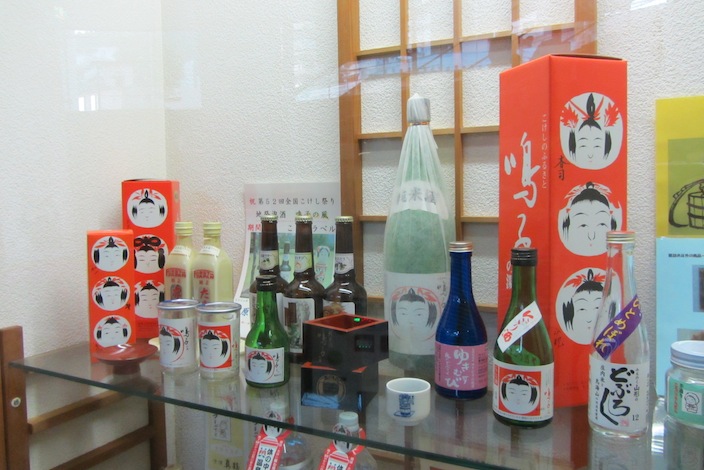
A display of kokeshi sake goods in the train station.
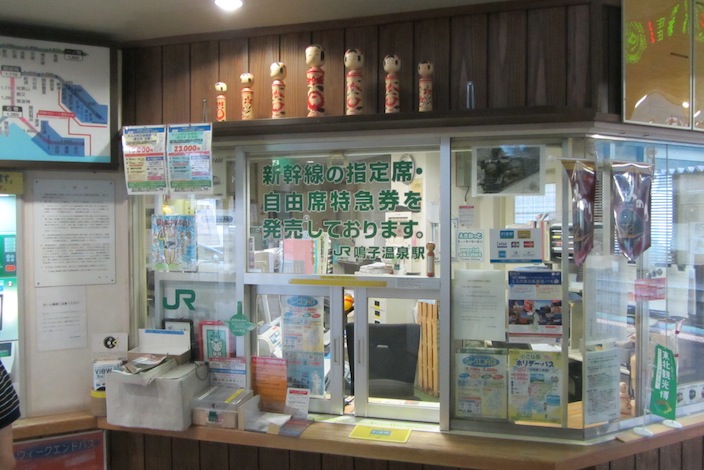
The Naruko train station's ticket window.
Looking into the Naruko station window.
A kokeshi display located on the second floor of the train station.
Truly the land of hot baths, this small foot bath was right outside the entrance to the station and was free.

Tuesday, September 18, 2012

Kokeshi Adventure on NHK World NHKワールドのこけし冒険

Hiyane Bookstore. The kokeshis are upstairs.
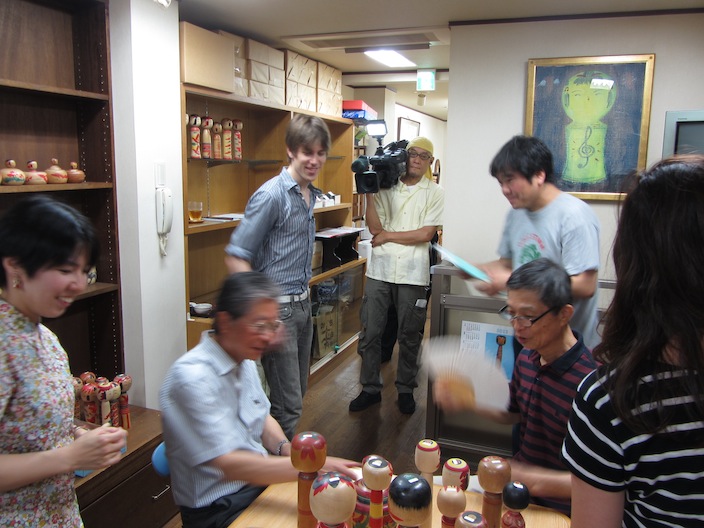
On July 28th Naoko and I headed down to the Kanda 神田 section of Tokyo. It wasn't for a Friends of Kokeshis meeting, though some of our fellow members were going to join us there. Instead we were heading for a small used bookstore named Hiyane ひやね, the second floor of which is actually a used kokeshi shop! I had no idea, and this in itself was quite interesting. The shop has lots of nice pieces available, but the real reason for the trip was that Naoko, myself, and a few other Kokeshi Friends were going to be interviewed for an NHK World TV show called Tokyo Eye. It was for a good cause really, as NHK World is hoping to promote an interest in the Tohoku region of Japan through showing its connections in Tokyo. Since kokeshis are such an important symbol of Tohoku this was an obvious choice. Tokyo Eye, for those who don't know, is a weekly show made for foreigners who are interested in Japan. The director was hoping to get an interview with a foreigner who has some knowledge about kokeshis, hence my participation in the program. Anyway, this was a kokeshi adventure of a different sort and I think everyone had a great time. I mean really, what wouldn't be fun about sitting around in a room full of kokeshis with fellow enthusiasts, and then talking about kokeshis on TV?
Naoko and I met for lunch beforehand at a small Chinese restaurant with the Tokyo Eye director Mr. Hiro Kay, the camera man and grip who stayed quietly in the background, Mr. Sato and Ms. Santo from Friends of Kokeshis, and the "talent" (as they call the on-air faces here in Japan), an American named Alex whose last name I forget. We chatted about the goal of the day's shoot, had some laughs, and then headed to the bookstore to record footage for the program.
Once there the NHK crew took footage of Alex working his way upstairs and talking to the camera in the style that's popular here in Japan. One thing they like to do on this sort of program is have the talent "discover" the object of the quest while on camera, at which point he or she feigns excitement. It's all rather scripted, but I happen to like it as a technique. Finally Alex and the crew walked into the room where we were standing, on camera of course, and proceeded to ask everyone a question or two about kokeshis such as why are we interested in them, do we think they're cute, and so forth. It was a lot of fun, although I think I might have ruined a shot when I pulled out my camera to take a picture of the camera guys doing an interview. Hiro waved at me not to do it, but it was too late, and I had to get the shot for this blog! Oh well. After Alex interviewed everyone (all in Japanese by the way, except for me), the camera guy took some video of a selection of representative kokeshis that we had picked out for use as B-roll. And that was it.
Coming up the stairs of Hiyane one is greeted by these kokeshis.
Some books and magazines were also available. 
Alex and Hiro discussing what to do next.
Preparing for the next shot.
The director isn't giving me a wave -- he's signalling me not to take pictures while they're recording! ごめんなさい。
An interview with the president of the Friends of Kokeshis Association, Mr. Hashimoto.
By now you might be wondering, what about the show? When is it going to air? Well, it already aired on NHK World on 12 September. However, it's apparently going to be turned into a Japanese-language version and shown on regular NHK, so if I get any information on that I'll make an announcement. Here's a link to the Tokyo Eye web site for information about the program, which I highly recommend if you've never seen it -- really a top-notch show. Tokyo Eye
Anyway, Naoko and I watched it and it was great! We were segment two of three on Tohoku-related topics, and the video was absolutely beautiful. Naoko, who was indeed interviewed, unfortunately did not make the final cut, but they did use part of my interview. Come to think of it, the show hardly used any of our interviews. Perhaps NHK will use that footage for another show sometime in the future? Our 5-minute segment followed an interview with Tokyo-based Kijiyama-style 木地山系 kokeshi craftsman Mr. Ogura Eiji 小椋英二さん whom Naoko and I visited last year at his business in Hachioji City 八王子市 outside of Tokyo. That was nice to see as well.
Alex: "You are kokeshi doll collectors?" Group: "Yes."
I took a couple of stills from directly off my TV set showing scenes from the program, so you can see that it came out really well. Most importantly is that Tokyo Eye showed its global audience about the wonderful tradition of kokeshis, which can only be positive. Hopefully it will encourage visitors to Japan to venture north to Tohoku and see some of the makers for themselves. Overall, this was a different but great kokeshi adventure!
Another still from the program. The guy sitting way in the back owns the kokeshi shop.

Saturday, September 15, 2012

Summer Kokeshi Adventure at Zao 2 蔵王で夏のこけし冒険a2

Easily the nicest looking kokeshi shop I've yet seen.
Continuing from the previous blog about our day-trip to Zao Onsen, the following is an entry about the second kokeshi maker's shop that we visited on 13 July: That of Mr. Okazaki Ikuo 岡崎幾雄さん, a 77-year old craftsman of the Zao 蔵王系 school of kokeshi making. As with last year Mr. Okazaki was not at his shop when we visited so we leisurely milled around looking at everything from the amazing kokeshis that he has created, to his personal collection of traditional kokeshis, to a nice selection of traditional Japanese wooden toys and modern kokeshis. The shop itself is so beautiful, both in terms of architecture and interior design, that it was a pleasure simply being there. In my opinion Mr. Okazaki's kokeshis, which have a baby-rattle body shape, are highly appealing, are of first rate quality. They're a bit more expensive than some other kokeshis, but well worth it.
Entering the shop.
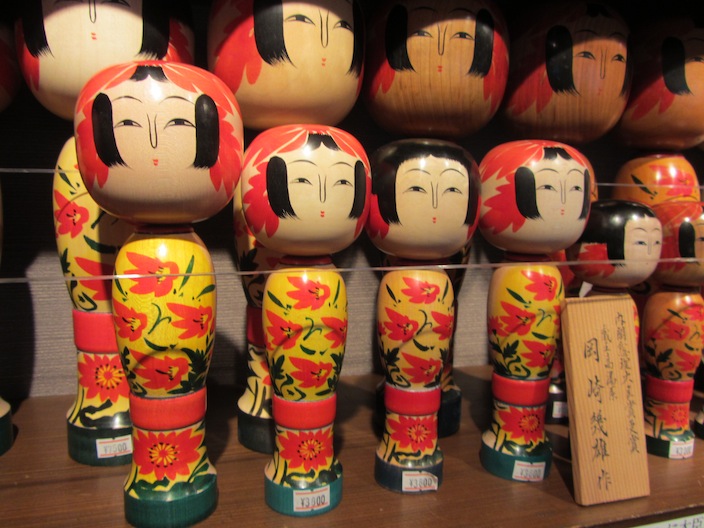
Behold! Rows and rows of Zao kokeshis.

Yellow is a dominant color among Mr. Okazaki's kokeshis.
Mr. Okazaki's pieces aren't cheap, but they're exquisitely crafted and of the highest quality.

Daughter number two standing next to a giant Hijiori kokeshi 肘折系.
I bought the one second from the left. It compliments another Okazaki piece that we got last year.

Part of Mr. Okazaki's personal kokeshi collection. Yes, kokeshi makers can also be kokeshi enthusiasts.
What an innovative use of a kokeshi head. The sign translates as "Michinoku Kokeshi Association Mutual Support Shop."
Mr. Okazaki's work area.


A couple of nice kokeshi tenugui 手ぬぐい. These are typically sold at the annual kokeshi events.


Traditional handmade wooden toys. These are all made in Japan and are just beautiful.
The shop has a nice selection of tops, wooden toys, and even modern kokeshis.
We purchased a few items (including some sulfur balls to use in our home bath) and then left the shop and headed down the mountain to the highway for our drive back home to Tokyo. It was the end of another spectacular trip to Tohoku, and the happy conclusion of a highly successful kokeshi adventure.