Wednesday, February 22, 2012

Akita Kokeshi 秋田のこけし

Farewell Kokeshi Kan!
Ok, now back to our summer 2011 Kokeshi Adventure. On June 26th, our sixth day up north, we bid a fond farewell to Nuruyu Onsen, but not before making a stop at the Tsugaru Kokeshi Kan to say a final goodbye to the staff. They were so welcoming and kind -- the people of Tohoku are like that in general. While at the Kokeshi Kan we met master Tsugaru kokeshi craftsman Mr. Kon Akira 今晃さん, and Naoko had a chance to chat with him a bit. His kokeshi painting style is, in a word, primitive, but his lathing work is exquisite. According to Naoko many other kokeshi makers really admire his ability and style.
Mr. Kon Akira working on the lathe.

Three pieces by Mr. Kon. The unpainted ones show his word working style.
We snapped this shot while driving out of the Nuruyu Onsen area.
Torrential rains and swollen rivers in Akita.
Our next destination was Akita Prefecture 秋田県 where we hoped to find the kokeshi workshop of Mr. Takahashi Yuji 高橋雄司さん. It rained pretty hard for most of the drive, in stark contrast to the blue skies we had had up in Aomori. After a couple hours driving south through the central part of the Honshu we finally discovered Mr. Takashi's workshop, which like most kokeshi makers, is also his house. Naoko had called on her cell phone so Mr. and Mrs. Takahashi were expecting us. They invited us in to their living room where we sat around a large floor table chatting and playing with small tops that Mr. Takahashi had made. They also served some snack, one of which looked just like makizushi (rice wrapped in seaweed), but lo and behold it was actually noodles that had been wrapped in seaweed and cut just like sushi. I had never seen that before, but that's apparently what they do in this part of Akita. Delicious!  
Akita farmland after the deluge. Beautiful.
This sign out front was the only indication that we had found the place: Yuji Kokeshi.
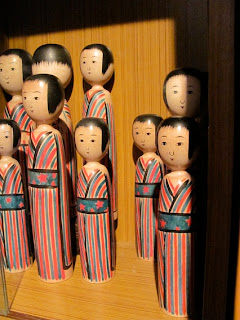
Mr. Takahashi showed us his surprisingly spacious workshop, tools, and wood supplies, and then we spent some time examining his kokeshis that were for sale. Kijiyama kokeshis are fairly unique in that the head and body are lathed from one piece of wood, and also that they tend to wear "clothing" rather than being painted with stripes or floral patterns. In that sense Kijiyamas tend to look much more doll-like than their cousins from other kokeshi schools.
The quality of Mr. Takahashi's kokeshis is readily apparent.
There's some variety among Kijiyama kokeshis, though the kimono style is dominant.
This perspective makes it hard to tell that these kokeshis are rather large but squat --  very appealing!
A selection of very nice Takashi kokeshis.
Mr. Takashashi showing us the variety of his work.
Mr. Takashashi in his workshop.
Mr. Takahashi gave us the full tour of his workshop, including a large supply of rough timber that will eventually become Kijiyama kokeshis.
Partially prepared wood.

Specialized kokeshi tools.
A well-used lathe that's undoubtedly turned out thousands of kokeshis. 
Calipers.
After a nice time and a purchase of different sized (small, medium, large) Kijiyama kokeshis we bid a fond farewell to Mr. and Mrs. Takahashi. We found our inn located in the onsen town of Yuzawa 湯沢温泉, located in central Akita in the middle of nowhere. It might seem as though there could be no such thing in Japan, but look for it on a map and you'll understand. Our hotel, a relic from the 1960s, was just ok, as was its onsen of which I can barely remember a thing. Oh well. Frankly, this place was a letdown after the spectacular Aomori leg of our vacation, and the rain didn't help either. Interestingly, our hotel was also home to a number of refugees from the 3-11 disaster, and we saw some kids running around who had likely been forced from their home just a few months prior. Meanwhile, our next stop was going to be Yamagata -- how would that be I wondered? Well, I'll discuss that in an upcoming blog as our kokeshi adventures continue! 
Oh, one more thing to mention. As we were driving back from the Takahashi's we saw this kokeshi workshop which shows that Yuzawa is something of a kokeshi area.  It was getting late but Naoko went up and knocked on the door. No answer. A failed kokeshi adventure.

Saturday, February 18, 2012

Hina Kokeshi 雛こけし

March 3rd in Japan is called Hina Matsuri 雛祭り, or Girls' Day, and every year people in Japan pull their Girls' Day dolls out of storage and put them on display. These displays, representing the medieval Japanese imperial court, are traditional dolls with elaborate clothing, hair, and even accouterments. There's also always a male-female pair. In my opinion they're interesting, but not overly so. Fortunately, both modern and traditional kokeshi makers have decided to make Hina kokeshis, which as a kokeshi enthusiast I obviously find much more appealing. Despite being a rather exotic branch of the kokeshi world they somehow manage to retain their fundamental kokeshi-ness, making them the clear choice for Girls' Day. From what I can tell a good number of traditional kokeshi craftsmen are making Hina kokeshis, so there's a large variety from all kokeshi families to choose from. Below are photos of our Hina kokeshis, a collection that will undoubtedly continue to grow in the future. 
Hina kokeshis by Mr. Hiraga Teruyuki 平賀輝幸さんfrom Sakunami Onsen 作並温泉 near Sendai City.
Tsugaru-type 津軽系 kokeshi craftsman Mr. Abo Muchihide's innovative fan-shaped Hina kokeshis. The faces are exactly like his normal, full-sized kokeshis by the way.
Hey! The heads come off and become tops! 
Abo Muchihide's brother Mr. Abo Kanemitsu made these fairly small Hina kokehis.
The bigger version of Mr. Abo Kanemitsu's Hina kokeshis. Look closely at the two pictures to spot the differences.
The image on the left is a poster for the on-going Hina kokeshi exhibit at the Tsugaru Kokeshi Kan, which ends on 20 March. Apparently it's so snowy up in Kuroishi right now that guests are few and far between, but if my family was living up in Aomori we would definitely brave the weather and go see the Hina kokeshi collection! The kokeshi art on the poster is of Mr. Abo's kokeshis pictured above. If the exhibit sounds interesting but you won't be able to get to Aomori to see it, please take at look at the Kokeshi Kan blog which has posted a number of pictures (February 2012 posts) of the collection. Here's direct link, which is in Japanese of course Kokeshi Kan Blog

I've probably given the impression that only traditional kokeshi makers are making Hina kokeshis, which is simply not the case. Here are a couple of very nice modern-style Hina kokeshis that, as usual, show how creative Japanese artists can be with a small piece of wood and some paint.
Modern ball-type Hina kokeshis. Fantastic!
Two more modern ball-type Hina kokeshis. Lena won these at the recent Modern Kokeshi Exhibition in Maebashi City. I'll have to blog about that soon.

Wednesday, February 8, 2012

A Shelf for Displaying Kokeshis


At last year's annual National Kokeshi Festival at Naruko Onsen I noticed that the kokeshi craftsmen's displays included some small shelves for displaying interesting pieces. Rather than pack the shelves with kokeshis, they were nicely spaced with just a few per shelf. I found that effect quite appealing and have been wanting to do the same thing in our apartment for quite some time, but wasn't quite sure how best to do it. That is until the other day when I came across a nice wooden shelf kit a the No Brand (無印良品) store. It was about 2,000 yen and couldn't have been easier to install. I put it in the hallway where there's nice lighting, and whenever we feel like it we can put out new kokeshis. As I have explained in previous posts, kokeshis are really quite nice just about anywhere in the house. However, giving them their own shelf makes them more like art objects for study. Right now we have two Yamagata kokeshis on display, but tomorrow there might just be one, or three. Naoko's already talking about getting another shelf for somewhere else in the house, so this is going to be fun. 

Our new shelf with a couple of beautiful Yamagata kokeshis.

Sunday, January 22, 2012

Tokyo Kokeshi Friends Association Meeting 3 東京こけし友の会3

Milling around before the meeting.
Mr. Suzuki Akira speaking to the group.
Mr. Nishiyama also said a few words.
On 22 January Naoko and I attended the first Tokyo Kokeshi Friends Association meeting of the year. This was the third meeting I've gone to, and once again it was lots of fun. I really enjoy beng with other kokeshi enthusiasts. Surprisingly, there were 107 people in attendance, versus the 80-85 that usually show up, so we really had to squeeze into the room. The meeting was also special in the sense that two traditional kokeshi makers joined us -- Mr. Suzuki Akira 鈴木明さん from Akiu Onsen 秋保温泉 near Sendai City, and Mr. Nishiyama Toshihiko 西山敏彦さん from Tsuchiyu Onsen 土湯温泉 in Fukushima Prefecture in the mountains west of the Fukushima Daiichi nuclear power plant disaster. Mr. Suzuki makes Sakunami 作並系 style kokeshis, while Mr. Nishiyama makes Tsuchiyu kokeshis 土湯系, and each attendee received one of each.  They both spoke briefly, and then we heard about how certain kokeshi makers are doing and learned of the passing of a couple of older craftsmen. After that we got to the kokeshis available for the drawing, and unlike previous meetings I've attended there were no used kokeshis -- every one was new. Ironically, even though today's crowd was 20% larger than other meetings, the selection was much smaller than in the past! As a result there were some serious moments of kokeshi-induced tension as we waited to hear our numbers being called since Naoko had her heart set on getting at least one kokeshi by Mr. Abe Shin'ya 阿部進矢さん. After the drawing members who had perfect attendance in 2011 received a special commemorative ejiko kokeshi, and then another drawing was held to give away a large number of kokeshis donated by various craftsman (I actually won a wooden New Year's dragon made by a Naruko craftsman). Overall, we had a great time, as did everyone else it seemed. Was this a kokeshi adventure? 
These are the two I received today. The one on the left is a Nishiyama, and the one on the right is a Suzuki.
Naoko's Nishiyama and Suzuki.
We picked up a copy of the latest issue of Kokeshi Jidai magazine. 
There were 15 Abe Shin'ya kokeshis available. Naoko was delighted, but would our numbers be picked early enough to perhaps get one? 
More kokeshis available for the drawing.
More.
Mr. Suzuki brought these tiny ejiko kokeshis.
The kokeshis available for the first drawing.
The yellow ejiko kokeshis were for the members who had perfect meeting attendance in 2011.
These were given away in a secondary drawing and included the address of the makers  on the attached cards so that the winners could write thank you letters. I won the dragon in the middle.
More kokeshis for the secondary drawing.
This one was fantastic!
Court noble kokeshis -- apparently for Girls' Day.
I was number 79, and Naoko was 78. Naoko was picked about two fifths of the way through, while my number was picked towards the end.
And what do you know? We managed to get two beautiful kokeshis by Abe Shin'ya. Mission accomplished!

Friday, January 20, 2012

New Year's Kokeshis 新年のこけし

Happy New Year fellow kokeshi enthusiasts! While I struggle to finish the long, drawn out tale of our summer 2011 grand kokeshi adventure I have decided to throw in a bit about our kokeshi new year. On 15 January 2012 we headed to Mt Akagi 赤城山 in Gunma Prefecture 群馬県, just north of Maebashi City 前橋市. As some of you may know Gunma is the center of Japan's modern kokeshi 近代こけし world, but as a result of the March 11th disaster one traditional kokeshi-making family has become part of the Gunma kokeshi scene: The Sato family (Seito-san, Mikiko-san, Hideyuki-san, and Yusuke-san) from Iwaki City いわき市 in southern Fukushima Prefecture was forced to relocate to Akagi because of the on-going aftershocks. We visited the Sato's just six days before the disaster (see blog from March 2011), and have watched their situation with concern and interest. Despite adversity they have managed to continue their art, and it has been a pleasure visiting them up in Gunma from time to time. During our trip to Mt. Akagi the other day we bought the two Sato pieces shown in the photo below and Naoko called them "Hatsu kokeshi" 初こけし, or "First kokeshi of the New Year." I loved that! So yes, these two Satos are our first kokeshis of the new year. I think "Hatsu kokeshi" will become a tradition.
Our "First Kokeshis" of the new year. The one on the left is by Seiko-san, and the one on the left is by Hideyuki-san. As you can see the quality of the craftsmanship, from the paint to the lathing to the finish, is exquisite. The time on Mt. Akagi has influenced Hideyuki's art -- the flower on his kokeshi is a local flower found around his home on Mt. Akagi.
Although not connected to New Year's, while I'm talking about the Sato family I did want to mention this amazing piece of artwork that we asked Mr. Sato Seito 佐藤誠孝さん to make for us. It's about one meter high by about 30 centimeters, and as you can see is just wonderful; a sort of 2-D kokeshi. There is a sub-category of kokeshi art such as this that I'll have to cover in a future post.
Meanwhile, since I'm talking about the new year I can't pass up a chance to talk about a couple of New Year's kokeshis that Naoko pulled out for display recently. The first is a Shishi-mai 獅子舞 (lion dance) kokeshi, made by Tsugura kokeshi craftsman Mr. Hasegawa Kenzo 長谷川健三さん of Hirosaki City. We met him and his son at the Hirosaki Neputa Kan 弘前ねぷた館 last summer, and this was easily his most unique creation. Is it really a kokeshi? I don't know, but it makes a nice New Year's decoration.
Naoko got this Shishi-mai at the Hirosaki Neputa Kan in Hirosaki, and it has a surprise...
Voila! The head is a top, the body is hollow, and inside is a small ejiko えじこ kokeshi.
But wait, there's more! Mr. Hasegawa hollowed out the head and put in two tiny tops. Remember, this is all hand-crafted.
This is also a New Year's kokeshi made by Mr. Suzuki Akira 鈴木明さん of Akiu Onsen 秋保温泉 in the hills outside Sendai (I'll talk more about that trip in an upcoming blog). This small piece (about one inch) really blurs the line between a modern and traditional kokeshi, though Mr. Suzuki was careful to keep the face traditional.